A gap in the law
A necessary duty, power or safeguard is missing or defective.
Write or repair the rule.Law reform · Maritime safety · Public policy
Safer voyages. Independent investigation. Practical protection for people, livelihoods and the sea.
The central argument
Saint Lucia already has substantial maritime law. The task is to keep what works, repair identified gaps and connect the law to everyday decisions: whether a boat is safe, who can operate it, when it can leave and what happens when something goes wrong.
Draft One supplies a complete first model reform Bill with continuing-law provisions. It covers the main maritime policy fields while preserving technical rules and commercial rights that need a separate, careful reconciliation before replacement.
A necessary duty, power or safeguard is missing or defective.
Write or repair the rule.The rule exists, but the service, staff or equipment may not deliver it.
Fund and manage the function.The available record does not establish what happened or what is operating.
Obtain the record.These are different problems. An unlocated record is not proof that a duty was ignored. Another offence cannot substitute for an available inspector or a maintained rescue boat.
Clauses 36–65
Count everyone. Match capacity, lifesaving equipment, crew competence and weather limits to the actual voyage.
Clauses 48–57, 77–84
Use a departure and return record, a reachable shore contact and a clear overdue-alert procedure.
Clauses 85–98
Keep evidence, appoint independent specialists, protect testimony and make recommendations visible.
Clauses 99–122
Identify the response lead, assess wreck hazards, keep response-cost records and connect liability to financial security.
Clauses 58–65, 117, 134–140
Provide practical competence routes, assisted access, proportionate fees and phased new requirements.
Clauses 123–140; Schedule 6
Give reasons, correction routes and prompt review of adverse decisions. Preserve existing property and commercial rights.
How the proposal fits together
Responsible roles: operator and master, with regulatory oversight.
Responsible roles: master, crew, shore contact and designated responders.
Responsible roles: responders, investigator, regulators and competent courts.
This is a map of the proposed responsibilities, not a finding about any particular voyage. Safety investigation explains prevention; courts determine liability within their jurisdiction.
Build on the actual baseline
The Shipping Act covers registration, mortgages, crew, safety, wrecks, salvage, limitation of liability and enforcement. Its arrangement reaches section 497, with inserted provisions. The Small Commercial Vessel Code already has legal force.
The review also located the 2025 Caribbean cargo survey and construction regulations. An older consolidated website is therefore only one part of the current-law check.
Shipping Act, Cap. 13.27: Act and amendment historyShipping Act, section 2A and scheduled Small Commercial Vessel CodeShipping (Caribbean Cargo Ship Survey and Construction) Regulations, SI 53/2025
The 2021 rules already provide investigation duties, protected records, a two-month commencement limit, an effort to publish within twelve months with an interim report if needed, and a 28-day response duty for recommendations.
The draft strengthens independence and public follow-through. This review also ensures that the replacement investigation office must be ready before the existing regime is displaced for new cases.
SI 160/2021, regulation 9: Factors causing a safety investigationSI 160/2021, regulation 17: Publication of safety investigation reportSI 160/2021, regulation 19: Safety recommendations
Ratifying a convention and establishing its precise domestic effect are different questions. Saint Lucia's existing treaty provisions must be reconciled with the relevant conventions, amendments, notices and liability rules.
Draft One proposes accessible implementation records and controlled updating. Technical orders must not quietly rewrite primary rights, court jurisdiction or maximum penalties. Existing lawful treaty effects and commercial rights continue during the reconciliation.
Territorial waters and the exclusive economic zone also carry different powers. Wreck, pollution and enforcement provisions must respect those jurisdictional limits.
Maritime Areas Act: framework and subsidiary ordersStatus of IMO TreatiesShipping Act, sections 493–495: International conventionsShipping Act, section 494: Conventions to prevail
Connect this to who controls changes in Saint Lucia's law →A direct policy connection
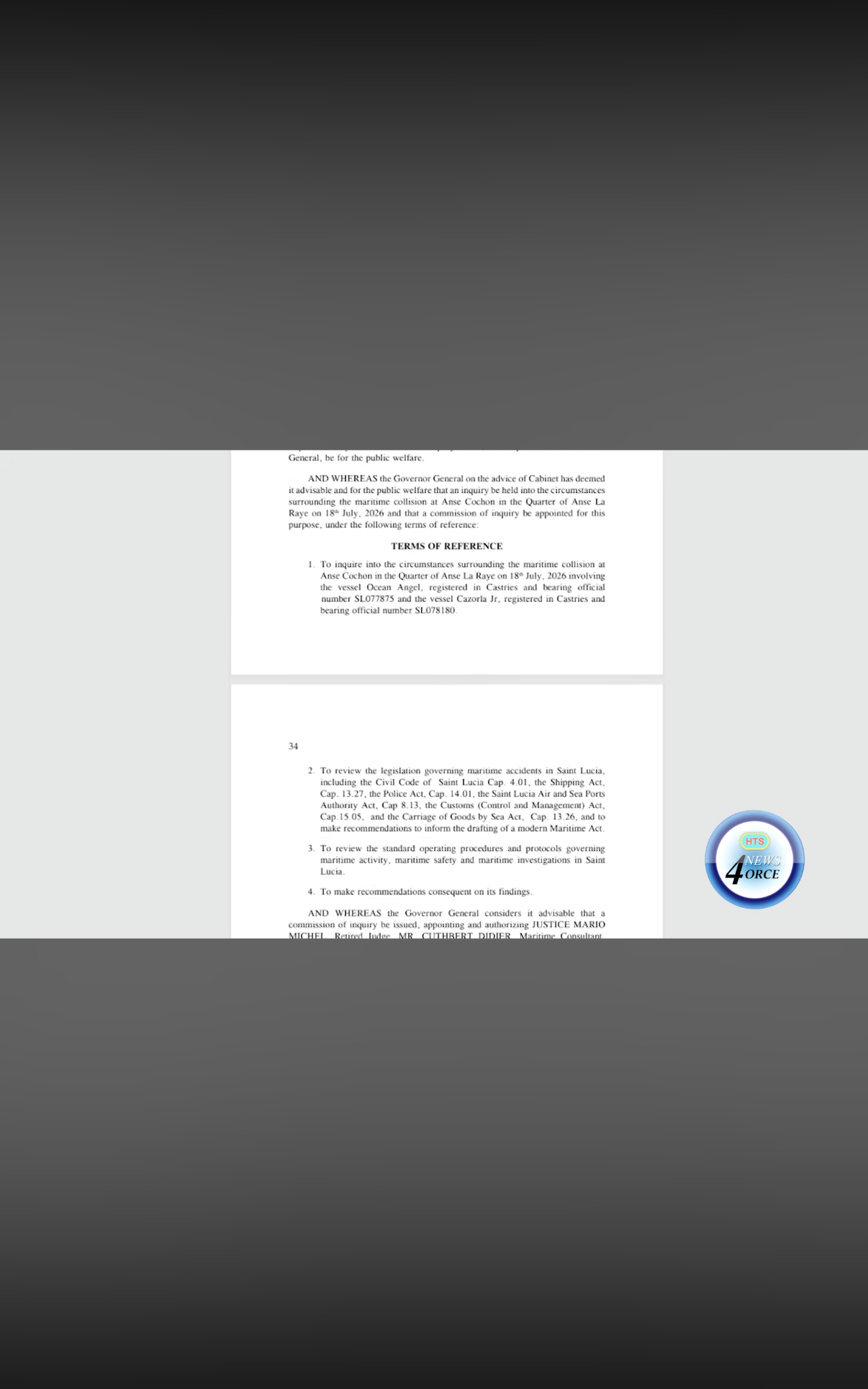
The Commission's remit expressly includes examining maritime legislation to inform a modern Maritime Act, as well as operating and investigation procedures. That makes this research directly relevant to its work.
Checked Gazette screenshots name Justice Mario Michel as chair, alongside Cuthbert Didier, Kentry Frederick and Luke Defreitas. They set an inquiry period from 8 September 2026 to 8 March 2027, with a written report to the Governor General due on or before 8 March.
The report deadline does not by itself establish a public-release date. Public proceedings are directed, subject to the commissioners' exclusion powers; a detailed sitting calendar is a separate matter.
The supplied Gazette copies carry an HTS News4orce watermark. The original official issue has not been independently retrieved. The stated inquiry period had not begun at this paper's 7 September cutoff.
Government Gazette Extraordinary, Vol. 195, Issue 16: Commission terms, pp.33–34Government Gazette Extraordinary, Vol. 195, Issue 16: Commission directions, p.34Government Gazette Extraordinary, Vol. 195, Issue 16: report deadline and instrument date, p.35
Comparative and local learning
The four comparators offer useful mechanisms, not a ready-made Act for Saint Lucia. Their fleet sizes, maritime trade, institutions and insurance markets differ. The paper explains what can transfer and what needs local testing.
| Comparator | What the paper studies | Useful lesson | Local test |
|---|---|---|---|
| Antigua and Barbuda | Small-craft regulation and published casualty work | Use clear operating categories, accessible technical rules and visible investigation outputs. | Keep local geography, staffing and enforcement capacity in the design. |
| Barbados | Liability and compensation legislation; practical transition experience | Connect victims' claims to the correct liability and insurance regime. Test how existing operators enter a new system. | A foreign threshold or policy limit needs a Saint Lucian legal and insurance assessment. |
| Jamaica | A broad shipping framework | Keep registration, crew, safety and commercial-law interfaces coherent. | Do not import provisions solely because the statute appears comprehensive. |
| Mauritius | An island shipping code with an updated consolidated text | Maintain technical law and make the applicable version easier to find. | Registry scale, staffing and maritime trade differ from Saint Lucia's. |
Small Craft (Control) Regulations 2017, No. 38 and scheduled codeCasualty ReportsMerchant Shipping (Liability and Compensation) Act 2024-30April 30 Deadline for Grandfathering-In ProcessTemporary Suspension of Grandfathering-In ProcessShipping Act: official text extractMerchant Shipping Act, consolidated Version 6
The cases include failures, difficult recovery questions and a successful rescue. They are selected studies, not a complete accident database. Some facts are officially recorded; others remain attributed reporting.
Separate the Commission, safety investigation, criminal proceedings and civil claims. Each answers a different question.
The policy question: Which finding concerns the law, which concerns delivery, and which requires more evidence?
Read the inquiry dossier →Water sports raise questions about swimmer separation, launch corridors, towing, lookouts and operator competence.
The policy question: Can the rules protect people in a shared beach area and be supervised in practice?
Read the contemporaneous account →A casualty can connect cargo, navigation, salvage, pollution and liability across jurisdictions.
The policy question: Can urgent environmental work proceed while preserving evidence, rights and cost records?
Read the paper's case study →A sunken privately owned tug illustrates the practical tasks of hazard control, pollution preparation and salvage.
The policy question: Who can act, who must be notified and which costs can lawfully be recovered?
Read the paper's case study →Long offshore survival and later repatriation put communications, independent alerting and regional coordination in focus.
The policy question: Would a credible overdue alert reach someone able to initiate a search?
Read the paper's case study →Beryl and earlier surge losses connect boat safety to livelihoods, storage, recovery finance and coastal exposure.
The policy question: Does the programme fund maintenance and preparedness as well as relief after loss?
Explore Soufrière's policy context →A reported rescue of five people shows the value of preparedness, timely communication and partnership.
The policy question: Which successful practices should become routine and be exercised regularly?
Read the paper's case study →Examine the proposed text
The draft proposes a lean Maritime Administration within the responsible ministry, with technical decisions protected from interference. Safety investigation has separate, independent leadership. A statutory corporation remains an alternative that would need different governance and financing provisions.
Registration, technical standards, crew claims, mortgages, salvage and other commercial rules continue except where expressly amended. The paper is a comprehensive first reform proposal; it does not claim to be a certified re-enactment of every existing shipping provision.
These are excerpts from the reviewed Draft One. Read them alongside definitions, linked provisions and schedules in the PDF.
(1) Sections 1 to 6, 134 to 137, 139 and 140 come into force on publication. The remaining provisions come into force on dates appointed by the Minister by order published in the Gazette.
(2) An order shall identify each provision commenced, the corresponding amendments in Schedule 6, continuing instruments and any transitional period. Sections 9 to 19 shall commence with items 1 to 5 of Schedule 6; sections 20 to 26 with item 6; and sections 85 to 98 with item 8. Section 7 and sections 123 to 133 shall commence no later than sections 9 to 19. No provision requiring action by the Administration shall commence before sections 9 and 10 and items 1 to 5 of Schedule 6. No adverse administrative power shall commence before its applicable notice and review provisions. Item 7 of Schedule 6 shall commence with sections 36 to 45 and no earlier than section 24. Each Schedule commences, to the relevant extent, with the provision giving it effect.
(3) Before commencing a new licensing, certification or financial-security requirement, the Minister shall publish the readiness statement required by section 136. Different dates may be appointed for objectively defined vessel classes. Existing requirements remain enforceable during a transition.
(4) Before an appointed date, the competent authority may make an appointment, designation or arrangement necessary to bring a provision into operation, but no substantive power under that provision may be exercised before commencement. No governance transfer shall take effect until a Director or acting Director and the officers necessary for continuity have been lawfully appointed or continued.
(5) Part X and item 8 of Schedule 6 shall not commence until a Chief Investigator or acting Chief Investigator has been lawfully appointed and a readiness statement under section 136 identifies funded arrangements for receiving casualty notifications, preserving evidence, obtaining necessary investigative expertise and publishing reports. The continuing investigation law remains applicable until that coordinated commencement.
Read this clause in the full PDF →Before departure, the master shall assess the voyage, forecast and observed conditions, vessel condition, loading, fuel and reserves, crew fitness, communications and safe destinations. The master shall not depart where a serious risk cannot reasonably be controlled within the vessel’s authorisation. An owner, customer or operator shall not penalise a master for a reasonable good-faith safety refusal.
Read this clause in the full PDF →A designated shore contact shall receive the vessel identity, master, intended route or area, persons aboard, expected return and escalation instructions. The master shall report material changes and safe return. The operator shall ensure an overdue report reaches the designated rescue contact without avoidable delay. Repetitive short protected-water trips may use an approved simplified system providing equivalent accountability.
Read this clause in the full PDF →(1) There shall be a Chief Marine Safety Investigator appointed by the constitutionally competent authority through a process requiring relevant investigative and maritime competence, independence and disclosure of conflicts.
(2) The appointment shall be for five years, renewable once, subject to the Constitution and lawful conditions of service. Removal before expiry shall be only for established incapacity, serious misconduct or material conflict incompatible with the office, with reasons and an opportunity to be heard.
(3) The Chief Investigator shall be operationally independent of regulators, port operators, police, commercial interests and ministerial direction in selecting, conducting and reporting a safety investigation. Administrative funding arrangements shall not permit interference with findings.
(4) The Chief Investigator may designate in writing a suitably qualified and independent person as an authorised safety investigator, specifying the investigation, functions, conditions and duration. The Chief Investigator is an authorised safety investigator by virtue of office. Designation does not itself appoint the person to the public service or confer powers beyond this Act’s jurisdiction. Evidence of authority shall be produced on request where practicable.
(5) Where the office is vacant, or the Chief Investigator is unable to act or has a conflict requiring withdrawal, the constitutionally competent authority may appoint a qualified and independent person to act in the office or in relation to the affected investigation. The requirements of competence, independence and conflict disclosure apply equally to an acting appointment. An acting appointment does not confer a substantive five-year term.
Read this clause in the full PDF →The Chief Investigator shall issue urgent safety recommendations whenever necessary without awaiting a final report. An investigation required under section 87 shall begin promptly and no later than two months after the occurrence. Where the Chief Investigator first learns of it after that period, it shall begin as soon as practicable and no later than seven days after credible notification, with the delay and reasons recorded publicly in non-sensitive form. The aim is final publication within 12 months of the casualty; where that is not possible, an interim report explaining progress, established safety issues and next steps shall be published within that period and updated at least annually. Where the Chief Investigator first receives credible notification after the twelve-month period, an initial public status report shall be published within 30 days of that notification and updated at least annually until final publication. This provision does not delay urgent recommendations or the commencement required by this section, or excuse an earlier failure to comply by a person or authority already under the relevant duty. Reports shall distinguish evidence, analysis, uncertainty and recommendations and omit unnecessary identifying and protected material.
Read this clause in the full PDF →A recipient of a safety recommendation shall consider it without delay and respond within 28 days, stating acceptance, alternative action or reasons for non-acceptance, responsible persons and proposed dates. Recipients shall notify material changes to their action or timetable. The Chief Investigator shall publish responses and maintain a status register, redacting protected, personal and specifically sensitive information. Before publishing information materially referring to a person, the Chief Investigator shall notify that person and consider factual representations received within 28 days, or an extended period for stated reasons. This consultation does not prevent an urgent safety recommendation from being issued without protected detail. A recommendation does not itself create a criminal duty or determine liability. A regulator may separately adopt a lawful rule or direction on the supporting evidence.
Read this clause in the full PDF →Regulations may require financial security for domestic commercial passenger carriage, vessel hire, designated higher-risk operations and wreck or pollution exposure outside compulsory treaty coverage. Before commencement, the Minister shall publish an insurance-market and affordability assessment, minimum policy terms, classes, limits, transition and accessible verification process. A prescribed insurance amount is not a civil liability cap. This power does not permit postponement of an already binding domestic treaty-insurance duty. Regulations shall set acceptance criteria for non-treaty providers, including adequate financial standing, enforceable terms, a service and claims representative, and the treatment of guarantees or other security. Minimum terms shall ensure effective compulsory protection under section 119. New policy protections apply to policies issued or renewed after the relevant commencement, with published transition arrangements for existing policies.
Read this clause in the full PDF →A readiness statement shall identify appointed officers, funding authority, applicable rules, forms, available survey and assessment services, public guidance, data arrangements, appeal access and treatment of existing permissions. It shall explain remaining constraints and how they are managed. The Minister shall not commence a new burden for a class where no practicable lawful compliance route exists, except a necessary immediate restriction on a serious risk under existing powers. Schedule 7 governs transition milestones and public progress reporting.
Read this clause in the full PDF →RIPPLE-4, sovereign options and public value
A new certificate or insurance requirement changes more than paperwork. People adapt. Costs move through households and businesses. Years later, the country inherits either useful capability or a system that is hard to repair. These are causal questions to test, not quantified forecasts.
Masters and operators face clearer voyage duties. Public bodies need staff, records and maintained equipment. Passengers gain more usable safety information.
Operators may repair, train or change routes and prices. Slow or costly certification can encourage avoidance. Insurers may add exclusions or decline particular risks.
Costs and delays can reach fishing income, fares, tourism suppliers, courts and emergency services. Reliable records improve coordination; shared errors can also spread.
The reform may leave trained inspectors, trusted records and effective regional agreements, or unfunded institutions, vendor dependence and displaced small operators.
Formal requirements rise faster than inspection capacity and affordable compliance. Some activity moves outside the formal system, leaving weaker records for rescue, oversight and learning. This is a scenario to test, not a finding about current operators.
The design response: Preserve current protections and require evidence of lawful authority, staff, recurring finance, access, cost and operational readiness before each new requirement starts.
Sovereign Option Theory
Safe voyages, credible independent investigation, environmental protection, workable compensation and lawful maritime livelihoods are the mission.
Commit first: Fund the legal concordance, fleet inventory, records preservation, existing inspections, practical training and response exercises. Then test departure records, assisted access, inspection capacity and insurance availability at representative landing sites.
Keep under review: Institutional form, software provider, equipment specifications for newly covered classes, new non-treaty insurance minima and the order of nationwide rollout.
Portable records, trained personnel, regional specialist agreements and tested procedures retain value even if the provider or institutional form changes.
Explore the sovereign-option assessment →Delivery and development
Inspect boats, train maritime professionals, govern its records, coordinate specialist assistance and change a failing supplier. These capabilities can serve the country even if the regulator's structure or software changes.
A public register should help people verify permissions. It must also let a person correct an error. A digital clearance system should reduce repeated filing and retain a lawful alternative when it is unavailable.
Institutional readiness: every new duty needs lawful authority, an accountable role, trained people, maintained tools, recurring finance and a review route.
These are proposed implementation checks. They do not create powers beyond applicable law.
If: An essential authority, staffing, funding, public-guidance or review requirement remains missing
Response: Hold that new requirement's commencement; publish the corrective responsibility and date. Existing safety duties continue.
Proposed responsible role: Responsible ministry, Attorney General and Finance
If: A material identity error affects permission, or an outage prevents lawful filing without a functioning alternative
Response: Contain the affected function, activate assisted or offline processing, and correct and reconcile records before expansion.
Proposed responsible role: Maritime Administration and participating agencies
If: The existing 28-day response period passes without the required response, or claimed completion lacks the agreed verification
Response: Apply lawful follow-up and keep the item visibly open until its status is verified. The response deadline is distinct from completion of the work.
Proposed responsible role: Independent investigator and recommendation recipient
A practical sequence
The paper proposes a staged programme after policy approval. These are planning phases, not enacted deadlines or a claimed Government timetable. Existing safety duties remain enforceable throughout.
Reconcile legislation and treaties. Map the active fleet and agency responsibilities. Preserve records, verify existing requirements, cost staff and identify maintained response assets.
Trial operating classes, certificates and departure records at representative landing sites. Obtain insurance quotations and specimen terms. Test practical competence and assisted access.
Transfer staff and records lawfully. Establish independent investigation, with working notification and evidence arrangements. Test electronic clearance outages before relying on the system.
Validate liability and compensation interfaces. Assess affordability and exclusion effects. Publish recommendation follow-through and complete the provision-by-provision reconciliation.
Legislative counsel should settle constitutional appointments, precise consequential amendments, treaty and liability limits, court procedures and financial implications. Actual staffing, fleet and insurance evidence must test the proposed requirements. Future Anse Cochon findings should inform the next revision.
Serious defects corrected; functional distress coverage; overdue-alert handling; survey timeliness; publication of reports; recommendation responses and verified completion; response exercises; lawful cost recovery; and the cost and accessibility of compliance.
Use reliable voyage or passenger-trip figures where available. Neither more inspections nor fewer reports alone proves that operations are safer.
Questions worth answering
Its existing rules support ownership, mortgages, seafarer claims, salvage, insurance and court remedies. Broad repeal can remove rights or create gaps. Draft One makes specified reforms while preserving those modules until each is checked and deliberately replaced.
No. Identity and ownership, safety certification, permitted use, operating area and activity licensing answer different questions. A useful public record should connect them while making those distinctions clear.
The proposal uses exposure and purpose. A small offshore fishing boat may need robust distress alerting; a personal watercraft near swimmers raises different risks. The rule should address the actual danger and offer a realistic route to compliance.
The paper proposes a lean ministry-based Maritime Administration with independent technical decisions and separate safety investigation. A statutory corporation remains an alternative, but requires its own staffing, governance and recurring-cost case. Creating an organisation is not proof that its functions work.
A requirement must correspond to cover that exists, can be verified and responds to the relevant claim. The draft preserves applicable treaty rules and phases additional domestic requirements after assessing actual terms, exclusions, prices and access.
Existing safety duties continue now. Legal reconciliation, fleet records, staff preparation and testing can advance. Findings from the Commission and any safety investigation should inform the next draft. This proposal makes no finding about the cause of the collision.
Safer operations, serious defects corrected, usable distress alerts, completed recommendations, timely surveys, accessible compliance and recoverable response costs. Where reliable data exist, compare casualties with voyages or passenger-trips. More reports can reflect better reporting.
Connected SLPA work
Follow the Commission's mandate, public participation and the separate safety-investigation questions.
Read connected research →Choose consciously which rules to retain and how future external standards become local law.
Read connected research →Give vessel data a correction route, access controls, portable formats and a working outage procedure.
Read connected research →Connect each new duty to an accountable office, recurring finance and evidence of delivery.
Read connected research →Turn specialist assistance and transport ambitions into practical agreements with clear responsibilities.
Read connected research →Protect people while building local maritime skills, safe enterprises and resilient supplier networks.
Read connected research →Boat permission is also distinct from land title, planning approval and public beach access. See the public-coast proposal for that separate legal and policy interface.
The full research and model legislation
By Kevin L. Michel
70 pages · 140 proposed clauses · 8 schedules · 76 linked sources
The review strengthened continuity for the independent investigator, addressed very late incident notifications, incorporated the supplied Gazette evidence and developed the RIPPLE-4 and sovereign-option implications.
The principal legal baseline is the Attorney General's 2023 online revised edition, supplemented by later original instruments and treaty records. Historic operating plans describe an organisational model; they do not establish present readiness. No confidential inspection files, watch logs, complete fleet census, insurance quotations or unpublished investigation files were available.
The paper distinguishes current law, proposed law, official records and attributed reporting. It makes no finding of fault in unresolved incidents. The next draft needs the original Gazette issue and any later directions, verified operational records and the eventual independent findings.
Suggested citation: Michel, K. L. (2026). A modern Maritime Act for Saint Lucia: Research, operational analysis and Draft One legislative package (reviewed Draft One, 7 September). Saint Lucia Policy Analysis.