The two-day record · 13–14 October 2026
Two days of testimony.
A clearer record.
An unfinished inquiry.
Twelve witnesses. Six transcript parts. Day 2 strengthens the accounts of life-jacket use and rescue, challenges an assumed lookout role, and adds detail about Cazorla Jr’s sinking. It still does not settle how the boats collided.
On this pageStart here
01 / Three-minute orientation
The record is stronger on preparation and rescue than on impact.
The strongest reporting starts with what was actually acknowledged, what witnesses describe, and where the evidence still stops.
On the night of 18 July 2026, two vessels collided near Anse Cochon on Saint Lucia’s west coast. Chair Justice Mario Michel opened the public sitting by describing four deaths, injuries, the destruction of one boat and the sinking of the other. The inquiry’s remit extends beyond the collision to maritime law, operating procedures and safety recommendations.
Day 1 exposed specific omissions: lights off during Ocean Angel’s departure, missing safety briefings, jackets not routinely distributed, an accepted operator-licence expiry and an owner who says he did not check it. Day 2 added six Cazorla passengers’ accounts. More testimony means better corroboration of some facts and clearer disputes about others; it is not six new views of the collision approach.
Day 1 Part III also sharpened the question of who was approved to command and who actually did. Cazorla Jr’s owner says the man named as master had never operated his boat. That makes the original certificates, approved conditions and the named men’s accounts essential. It does not, on its own, establish fraud, agency complicity or why the vessels collided.
- Both boats suffered serious consequences.Pascal’s Cazorla Jr sinking account gains detail from Butcher and Lester. Ocean Angel witnesses describe breakup and overturning, with floating remains used by survivors from both boats. Neither boat is established as an intact, serviceable survivor.
- The warning accounts must stay separate.Elias alleges that women aboard Ocean Angel asked Dylan to slow and he did not; Dylan denies a request. Pascal says Tyson immediately complied aboard Cazorla Jr; Williams corroborates the reduction and says it was maintained.
- A precise collision reconstruction remains missing.Recalled times, engine RPM, unseen approaches and a commissioner’s damage proposition cannot establish measured tracks, an impact angle, impairment or fault.
The people behind the inquiry
These are the four names in the police-attributed 22 July account. Tyrone Paul appears in testimony and later family reporting; the precise full-name crosswalk remains unresolved. We retain Tyrone Elivique for the reported deceased and do not add another casualty from a name variant. Respectful coverage should preserve both identity accuracy and the distinction between evidence about the collision and conclusions about each death.
New / The evidence evolves
What changed on Day 2?
Later testimony should change the analysis where it supplies new evidence. These are six consequential updates—not findings of the Commission.
13–14 October
across both days
originals retained
stable source links
Corroborated in testimony
The jacket was worn.
- Day 1 position
- Day 1 described a request, retrieval and stop.
- What Day 2 adds
- Williams says Taylor helped him put it on before impact. Lester describes the same fitting. Butcher later accepts that his different wearer identification was an assumption.
Still open: A verified equipment count, fitting assessment and individual survival causation remain absent.
Material dispute
A bow seat is not an assignment.
- Day 1 position
- Pascal identified Mavado as the return lookout.
- What Day 2 adds
- Butcher/Mavado denies taking that role. Chris ultimately says he inferred it from where Butcher sat. Lester says he does not know whether Butcher was assigned to keep watch.
Still open: Assignment, actual attention, sightline and warning are different questions.
Additional witnesses
Tyson’s assistance has recipients.
- Day 1 position
- Tyson said he went into the water to save two people.
- What Day 2 adds
- Taylor and Williams each describe receiving his help toward Ocean Angel’s floating remains. Edward describes directing him toward the pair.
Still open: Post-impact assistance does not settle pre-impact navigation responsibility.
Physical evidence needed
Cazorla’s final minutes are clearer.
- Day 1 position
- Pascal described damaged steering, a shoreward attempt and sinking.
- What Day 2 adds
- Butcher and Lester add accounts of the engine/control problem. Lester describes retrieving jackets while the boat flooded; a questioner challenges the hatch account.
Still open: No technical failure diagnosis, exact sinking time or authenticated damage sequence follows from testimony alone.
Inference exposed
“Enough” did not mean counted.
- Day 1 position
- Equipment availability was discussed without a verified inventory.
- What Day 2 adds
- Chris acknowledges that his claim of enough jackets for everyone was an assumption. One jacket successfully retrieved is not proof of suitable equipment for every occupant.
Still open: Count, sizes, condition, storage and speed of access all need evidence.
Documentary follow-up
Training and authority must be separated.
- Day 1 position
- Qualifications had often been described with loose labels.
- What Day 2 adds
- Edward’s examination distinguishes a course certificate from an operating licence. The chair orders production through Soufrière police by noon on Friday 16 October.
Still open: The record ends before that deadline. Compliance and the contents of the documents are not established here.
Choose your depth
One investigation. Several ways in.
02 / The vessels
Two craft. Two identity questions. Two damaged boats.
Photographs help identify and understand a vessel. They do not prove its condition on the night, its exact load or the collision mechanics.
Ocean Angel
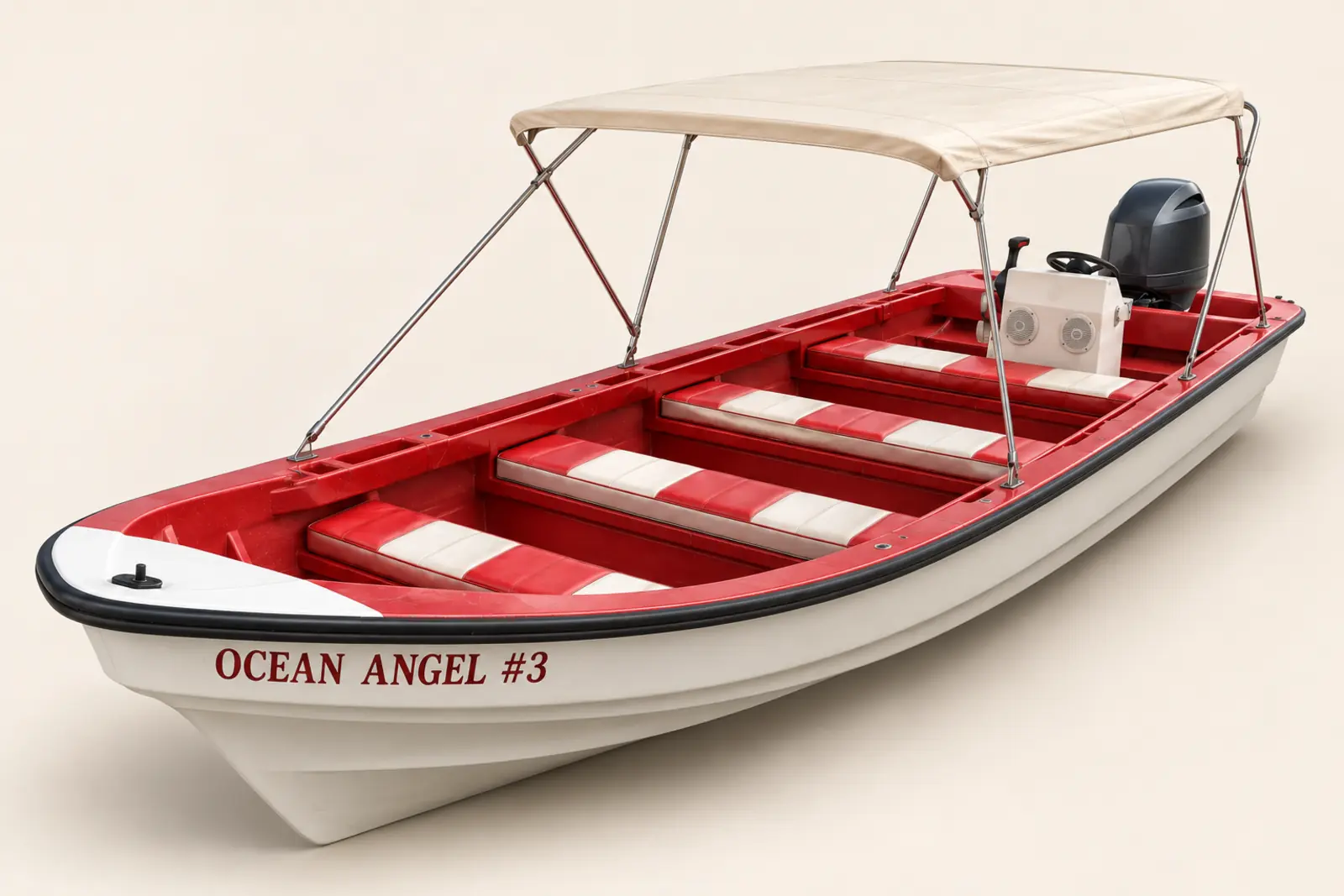
SLPA’s highly likely working identification is Ocean Angel #3. Converging markings and configuration, together with additional research supplied by Kevin L. Michel, support that assessment. Registry history and image dates are still needed; the number discrepancy cannot safely be dismissed as a typo.
- Journey
- Northbound from Soufrière. Tyrone initially steered; Dylan Nicholas says he held the helm at impact.
- Configuration
- Red-and-white open passenger layout, aft console and one visible outboard in the selected images. Dylan describes one 200 hp engine; the equipment record remains to be checked.
- Aboard
- Nine in the testimony: Dylan, Tyrone, Roxan, Elias, Debbie, Bradley, Marvin, Marley and an unnamed woman from Choiseul. First names and spelling variants are not a certified manifest. See the name and role register.
- After impact
- Described as broken, overturned and missing its bow. Survivors describe floating remains and jackets.
Cazorla Jr
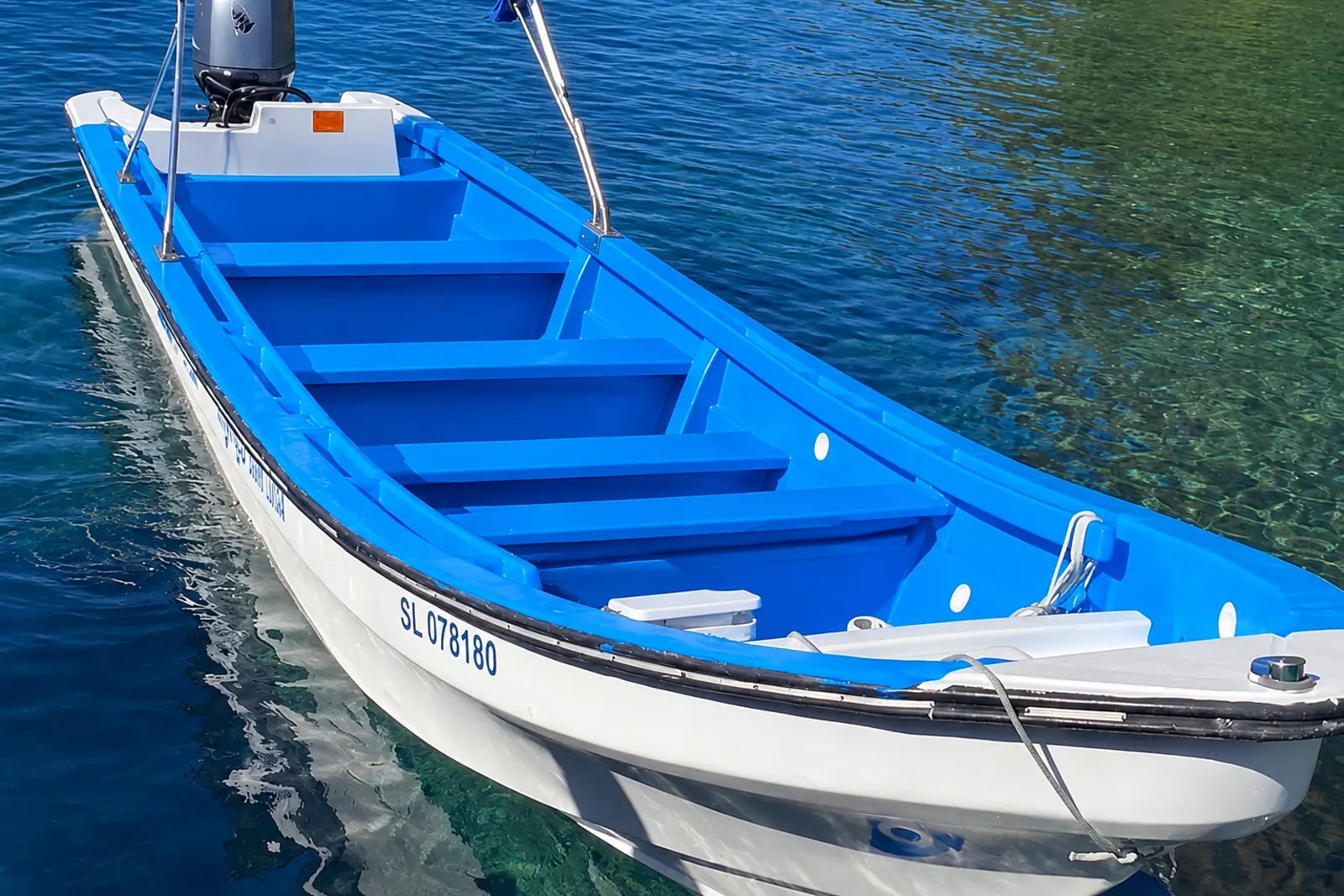
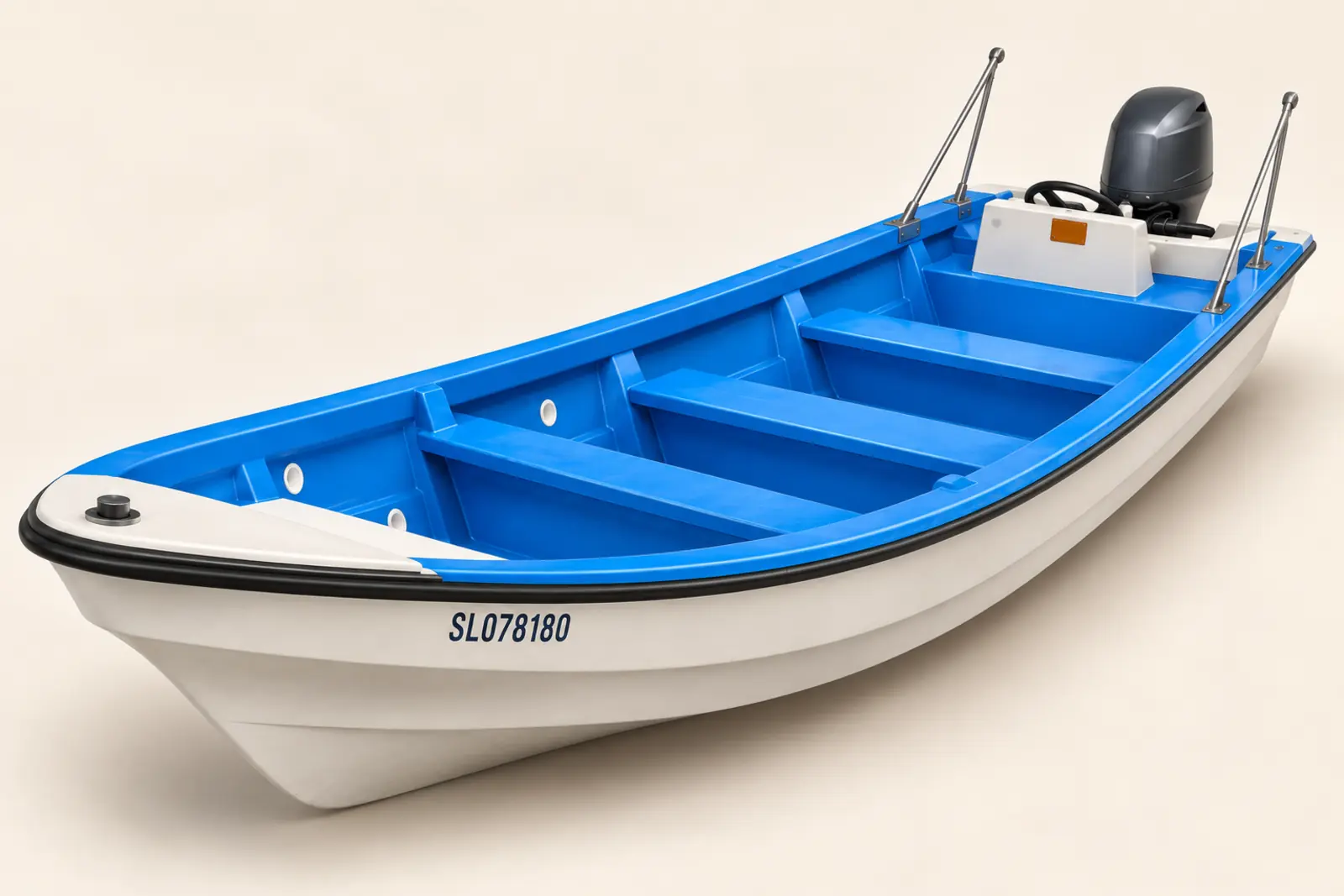
The Mango Tours photograph visibly carries SL078180, matching Cazorla Jr in the inquiry notice. This is a strong photographic identifier lead. The photograph’s date and the owner/registry crosswalk still need authentication.
- Journey
- Tyson Hippolit describes an outward trip to Gros Islet and operated the southbound return. Owner Ireanius Pascal was aboard.
- Configuration
- Blue-and-white open passenger craft in the selected photograph. Pascal explicitly confirms 150 hp; that is owner testimony, not a verified engine or speed measurement.
- Aboard
- Nine reported aboard; the names are not fully reconciled. Eight people are directly linked across the two days. Nyall and Wabi are additional unresolved references that may overlap those identities. Read the provisional register, not a certified manifest.
- After impact
- Pascal describes disconnected steering, an engine still running, a failed attempt to move towards shore and sinking.
Owner, named master, regular captain and actual operator are different roles.
Matthew’s and Paul’s direct accounts and SLASPA’s detailed explanation are not included in this two-day record. Their knowledge, consent, qualifications and the legal effect of the arrangements cannot be inferred solely from Pascal’s account.
03 / People and roles
Who is asking, and who is answering?
Four commissioners and two inquiry officers have distinct functions. Twelve people gave oral evidence across the supplied two-day record. Being named in an investigation file is different from testifying or being aboard.
The Commission and its officers
Justice Mario Michel
Chair; retired judge.
Cuthbert Didier
Commissioner; maritime consultant.
Kentry Frederick
Commissioner; retired Police Marine Unit superintendent.
Luke De Freitas
Commissioner; Assistant Commissioner of Police.
Lenita Joseph
Commission secretary; retired permanent secretary.
Shahida Charlemagne-Octave
Legal counsel to the Commission, not a commissioner.
The inquiry may recall witnesses. Commission counsel is not automatically counsel for a witness or family. Its fact-finding and reform work should not be treated as a criminal determination.
Twelve witnesses, in hearing order
DAY 1 · PART I
Corporal 153 Luciano Guard
Police investigator, Marine Intelligence and Investigations Unit. Police-file evidence and outstanding records. Surname is user-reviewed in the Day 1 reading edition; not independently audio-verified.
DAY 1 · PART I
Roxan Bonapart
Passenger on Ocean Angel. Name rendered Roxan Bonapart in the supplied transcript; spelling unverified. Described speed, lights, a life-jacket request and rescue. Did not see the collision itself.
DAY 1 · PART I
Dylan Nicholas
Ocean Angel operator at impact; managing director of Ocean Angel Boats. Accepted several omitted precautions; disputed accounts of excessive speed and unlit travel after he took over.
DAY 1 · PART II
Elias Nicholas
Ocean Angel passenger; fisherman. Described the operator change, passenger warnings, capsize and rescue. His view forward and memory after injury were limited.
DAY 1 · PART II
Tyson Hippolit [spelling provisional]
Operator of Cazorla Jr. Accepted a displayed licence expiry date, admitted beer consumption and described his lights, lookout and rescue actions.
DAY 1 · PART III
Ireanius Pascal [spelling provisional]
Owner of Cazorla Jr and aboard that night; tour operator. Gave sworn oral evidence about the substitute operator, named-master paperwork, omitted precautions and his vessel sinking after impact.
DAY 2 · PART I
Taylor Riviere
Cazorla Jr passenger. Describes the jacket request, her injury and Tyson’s assistance. Did not see the approaching boat. Rivier/River variants remain in the source.
DAY 2 · PART I
Romaine / Romeon Williams
Cazorla Jr passenger; Taylor’s companion. Confirms wearing the jacket and the immediate, maintained slowdown. Describes Tyson’s assistance. First-name spelling remains provisional; Williams with an S is confirmed in testimony.
DAY 2 · PART II
Jean Pierre Ralph Edward
Cazorla Jr return passenger. Self-identifies and confirms membership. His training/current-licence distinction, light-side answers and stop location are tested.
DAY 2 · PART II
Butcher, also known as Mavado
Cazorla Jr passenger seated at the bow. Denies agreeing to be lookout. Clarifies he assumed who wore the jacket. First name appears in inconsistent automated forms.
DAY 2 · PART II
Chris · surname transcribed Jabatis
Cazorla Jr passenger. Describes lights and seating, then concedes his lookout and sufficient-jacket claims were assumptions. Surname needs verification.
DAY 2 · PART III
Lester Jean / Soya
Cazorla Jr passenger. Adds the post-impact steering, jacket retrieval, sinking and Ti Kaye evacuation account. Jean/Soya is the working cross-source form; raw text varies.
Name forms remain provisional where indicated. The people register separates confidence that someone was aboard from confidence in spelling, aliases and assigned roles. Original automated forms remain searchable.
Explore what each witness said →04 / What happened that night?
Two journeys, an unobserved gap, several rescue accounts.
The accounts establish an order of reported events. They do not supply a common clock or a defensible drawing of the boats coming together.
The coast gives the accounts context.
Ocean Angel’s journey was northbound from Soufrière. Cazorla Jr was returning south after a trip to Gros Islet. The hearing identifies Anse Cochon as the collision locality. Elias describes one rescue landing at Canaries.
Those place names do not establish a vessel’s distance offshore, a route around a landmark, a sinking position or a measured contact point. The map deliberately shows places rather than vessel tracks.
The official 6 p.m. forecast on 18 July warned of locally rough seas within 25 miles and waves or swells of 6–9 ft. This establishes a forecast available before departure, not the wave height or visibility at the collision.
Ocean Angel · Reported northbound journey
A change at the helm
- Departure and takeoverTyrone initially steers. Dylan takes over. Dylan acknowledges an unlit departure, then says he switches lights on.
- Warnings and limited viewsRoxan describes fast travel and a jacket request; Elias reports the women’s slow-down concerns. Both have limited forward views. Dylan disputes the warning account.
- A claimed sighting and turnDylan says he sees red and green lights and alters to starboard. The distance, interval and extent of the turn are not measured.
Cazorla Jr · Reported southbound return
A slowdown and a later stop
- The return from Gros IsletTyson is operating. Pascal’s departure-time and journey-duration estimates are approximate; he did not check the clock.
- A request to ease offPascal says he asks Tyson to slow near Windjammer because of choppy conditions. He says Tyson immediately complies and does not accelerate again.
- A jacket fitted to WilliamsPascal describes a later stop. Williams now directly describes wearing the jacket Taylor helped him put on, with impact an estimated two to five minutes later. The exact stop location and interval remain unresolved.
The central gap
Contact is not reconstructed.
A claimed turn, no reported sighting from the other operator, passengers’ obstructed views and disputed damage propositions do not resolve the impact angle. No collision vectors or individual injury trajectories are asserted here.
Ocean Angel’s aftermath
- Breakup, overturning and flotationDylan describes a broken hull; Elias describes the capsized craft and a floating jacket. Roxan’s memory jumps from the jacket discussion to being in the water.
- Separate rescue recollectionsRoxan describes a boat responding to a phone light. Elias recalls reaching Canaries with Debbie’s body and later losing awareness. Their estimates do not time the whole response.
Cazorla Jr’s aftermath
- Neutral and assistanceTyson says he enters the water to help. Taylor and Williams now identify themselves as recipients of his assistance toward floating Ocean Angel remains; Edward also describes directing him toward them.
- Failed steering, sinking and a callPascal’s engine and steering account gains detail from Lester and Butcher. Lester describes jackets retrieved as the boat flooded, followed by a separate evacuation through Ti Kaye. Damage, movement and rescue times still need records.
Interactive account explorer
Follow each account at your own pace.
Eleven passenger and operator accounts across both days. Play, pause or step through the sequence. Reduced-motion and readable text views preserve the same evidence. The visuals explain testimony, not a forensic reconstruction.
A clearer aftermath
Follow the rescue accounts without merging them.
Different survivors describe different paths to safety. The lanes below show reported sequence, not synchronized time, distance or a complete list of rescue craft.
Through Canaries
- Cazorla Jr → water
Both describe impact and finding themselves in the sea.
- Tyson → floating remains
They describe his help toward Ocean Angel wreckage; Taylor later stays alongside it.
- Phone light → rescue craft
Williams describes signaling. The witnesses name a rescuer called Cafu; the full craft/load record is still missing.
- Canaries → care
Pickup transport to Soufrière Hospital, then Taylor’s onward medical transfer. Williams says he was uninjured.
Through Ti Kaye
- Damaged Cazorla Jr
He remains aboard during the steering problem and attempt to move toward shore.
- Jackets → water → yacht
He describes retrieval, sinking, then swimming to a yacht seeking help.
- Rescue craft → Ti Kaye
He describes a later male group from Cazorla and waiting ashore.
- Another boat → Soufrière
He says an ambulance did not arrive during his wait. Dispatch status and elapsed time need records.
05 / Compare the evidence
Some differences matter. Others come from asking different questions.
Read the statements alongside their limits. An admission, an observation, a reported remark and a questioner’s proposition carry different evidential weight.
The table scrolls horizontally on small screens. Select a source reference to read the underlying passage without losing your place.
| Issue | Ocean Angel account | Cazorla Jr account | What the comparison establishes |
|---|---|---|---|
| Speed and warnings | Roxan and Elias describe faster travel after Dylan took over. Elias says three women asked him to slow down and he did not. Dylan denies receiving a request. | Pascal says Tyson slowed immediately. Williams corroborates both the instruction and maintained reduction. Edward initially says he was comfortable, then agrees under questioning that the pace was too fast for conditions. | Do not combine the voyages into a claim that both operators ignored warnings. Perceived pace is not measured speed. |
| Navigation lights | Dylan accepts an unlit departure but says he switched the lights on. Roxan and Elias say they observed no lights. | Taylor, Williams and later passengers add observations of Cazorla’s lights. Edward initially reverses port/starboard colours. These accounts need to be read with each person’s actual view. | Departure, switch position, functioning lamps and what a seated passenger could see are separate propositions. |
| Lookout and approach | Dylan names Tyrone as lookout but says he personally saw red and green lights without a report from him. The passengers did not see the other boat approach. | Pascal names Mavado as lookout. On Day 2 Butcher/Mavado denies that role. Chris ultimately says he inferred the role from the bow seat; Lester says he does not know whether Butcher was assigned to keep watch. | An assigned role, a forward seat and effective observation are three different claims. The conflict is live; non-observation does not prove Ocean Angel was unlit. |
| Life jackets | Dylan accepts that nobody aboard was wearing one. Roxan says she asked for one and did not receive it before the collision. | Williams directly describes wearing the jacket Taylor helped him put on. Lester also describes that fitting. Butcher’s initial claim that a woman wore it is later reduced to an assumption. | Wearing is now supported by direct testimony. Adequate stock, sizing, fit and the effect on individual outcomes are separate questions; Chris did not count the jackets. |
| Impact and damage | Dylan describes a claimed starboard turn and a broken, overturned vessel; contact-side questioning exposes unresolved differences. Elias did not see contact. | Pascal’s post-impact steering and sinking account gains detail from Butcher and Lester. Lester’s bow-hatch recollection is challenged against the recovered boat’s condition. | Neither a survival inference nor a damage proposition establishes an angle. Steering failure is described after impact, not established as its prior cause. |
| Survival and rescue | Witnesses describe floating material and jackets. Elias describes rescue to Canaries; Roxan describes a later boat responding to a phone light. | Taylor and Williams identify themselves as receiving Tyson’s help to reach floating Ocean Angel remains. Edward describes directing Tyson toward them. Lester describes a separate evacuation through Ti Kaye. | Rescue assistance is now corroborated in testimony. It does not determine navigation responsibility. Different rescue trips and casualty identifications must not be merged. |
A closer audit of apparent contradictions
The purpose is to identify the exact proposition that needs testing, rather than treat confusion in an imperfect transcript as proof of dishonesty.
A lookout assignment is disputed; a seating-based assumption is exposed.
Pascal’s Day 1 attribution must now be read beside Butcher’s denial. Chris initially calls Butcher the lookout, but later says he assumed this because Butcher was at the bow. Lester says he does not know whether Butcher was assigned to keep watch. A concession elicited by an examiner does not settle every person’s knowledge.
The consequence for reporting: Seek the actual instruction, acceptance, position and communication. Do not describe Butcher as an established negligent lookout or assert that nobody performed any observation.
“The girl wore it” becomes “I assumed”.
Butcher first insists a woman wore the jacket. Under later questioning he says he handed it over, sat back and did not watch what followed. Williams describes wearing it himself; Taylor and Lester describe helping or seeing it fitted.
The consequence for reporting: Report the narrowed answer, not just the earlier confident claim. Retrieval and witnessing the final wearer are different observations.
A training certificate is not automatically an operating licence.
Edward’s account shifts between being certified, holding a course certificate and still obtaining a licence. The chair separates these categories and directs production of the documents by noon on Friday 16 October at Soufrière police.
The consequence for reporting: The documentary question is unresolved at this cutoff. This directive is not proof that documents were later delivered, nor that every earlier technical answer was expert evidence.
Recovered damage is not automatically the condition immediately after impact.
Lester says he opened a bow hatch to retrieve jackets as Cazorla flooded. An examiner says the recovered vessel’s damage made that impossible. Lester maintains his account and raises the possibility of later damage. The relevant photographs and recovery sequence are not reproduced in these transcripts.
The consequence for reporting: Identify the same compartment on dated images, distinguish impact from sinking and salvage damage, then put that evidence back to the witness. The exchange does not prove dishonesty.
“Enough jackets” was not based on a count.
Chris describes jackets being available and initially says there were enough for everyone. Follow-up establishes that he did not count them and was assuming sufficiency. A jacket later retrieved for Williams is evidence of availability of that jacket, not a nine-person inventory.
The consequence for reporting: Obtain quantity, sizes, serviceability and storage evidence. Keep equipment carriage separate from usable access and wearing.
Rescue identities and rescue loads remain distinct.
Elias’s Day 1 account names Debbie on a rescue boat; Taylor’s Day 2 account names Miss Nestor. They may describe different trips, incomplete observation or an identification error. Lester’s later group went through Ti Kaye, while Taylor and Williams describe Canaries.
The consequence for reporting: Reconcile each rescuer, craft, load, landing and medical handover. Do not substitute a casualty name or infer that every survivor travelled together.
The “15 minutes” is not a proved warning interval.
Dylan repeatedly explains his approximately fifteen-minute estimate as the interval from taking the helm to the collision. Questioning compares it with a much shorter estimated distance to the lights. Those endpoints cannot be substituted for one another. Engine RPM, prompted knot estimates and utility-pole distances also do not make a measured reconstruction.
The consequence for reporting: Establish separate times for departure, helm handover, first sighting and impact before calculating reaction time or closing speed.
Elias’s answer was qualified before the apparent reversal.
A question asks whether anybody “other than the girls” requested a speed change. The chair later restates this broadly as nobody having complained. The final clarification restores Elias’s account that the women complained and Dylan did not slow. The omitted qualifier matters to any assessment of his consistency.
The consequence for reporting: Read the question and answer together. A separate stable/unstable wording problem remains unresolved without the recording; its cause should not simply be attributed to transcription.
Pascal gives several intervals, not one synchronized clock.
His estimates concern the time from slowdown to jacket request, from the request to impact, and from slowdown to impact. The first two intervals can both be true. His separate fifty-to-sixty-minute estimate creates the need to reconcile all three endpoints.
The consequence for reporting: Williams now directly describes wearing the jacket. Its exact stop location and timing still need reconciliation; neither his survival nor the request establishes a measured speed.
An expired licence and a later expiry are different issues.
Tyson accepts the displayed 18 July 2015 expiry. The hearing separately discusses Graham Matthew’s 28 September 2026 expiry and a vessel-certificate expiry in November. September follows the July collision; different documents can also have different expiry dates.
The consequence for reporting: Report Tyson’s admission accurately and seek the original record and renewal history. Do not backdate Matthew’s September expiry or treat nonmatching document dates as an offence by themselves.
A discrepancy in staffing warrants documents, not a fraud verdict.
Pascal says Graham Matthew was named as master but never operated his boat, Daryl Paul was its regular captain and Tyson operated that day. He says the insurer accepted Paul while SLASPA sought a different licence level. The legal conditions, approved substitutions and the absent named men’s accounts are not supplied here.
The consequence for reporting: The admission establishes a serious paper/practice question. It does not establish Matthew’s consent, Paul’s lack of all qualifications, insurance invalidity, forgery or official complicity.
Consumption, demeanour and survival are not technical measurements.
Tyson admits at least four beers, but the record does not establish his blood-alcohol level or impairment. Pascal’s tone is challenged; that does not establish indifference. The suggestion that a forward lookout should have been killed or badly injured is also not a reconstruction.
The consequence for reporting: Use direct observations, contemporaneous records and appropriate technical evidence. Neither a panicked first call nor a person’s survival proves the cause of the collision or an avoidable individual death.
Two days of source-linked evidence
Inspect the claim, its status and its limit.
The expanded evidence explorer retains all Day 1 entries and adds Day 2 evidence, with separate follow-up notes where later testimony changes the evidential position. Search by person, vessel or issue, and move from an analytical statement to its exact transcript location.
06 / Editorial assessment
What the Commission did well—and what needs firmer proof.
The Commission exposed serious operational questions and widened the record across two days. Its next task is to connect pointed questioning to authenticated documents, direct witnesses and explicit reasoning.
Michel set out the remit, explained representation and safeguards, and kept open the possibility of recall. The panel’s strongest exchanges narrowed broad assertions into checkable claims. Its weaker exchanges risked letting an interpretation become the premise of the next question before the underlying fact had been established.
That is a reason to examine the process carefully, not to dismiss the inquiry. A public record becomes stronger when its corrections and limits are visible. The same standard should apply to this coverage.
What strengthened the record
Procedural care and useful clarification
Michel sought documents rather than accepting a label.
The chair disentangled Edward’s training certificate from an operating licence and set a specific delivery deadline and location. That turns a repeated verbal claim into a checkable evidential task.
The chair protected a witness while keeping the inquiry moving.
During Lester’s yacht account, Michel stopped detail that could prejudice a separate pending criminal matter and returned to the rescue chronology. That is a concrete procedural safeguard; it settles nothing about the separate charge.
Follow-up separated observation from assumption.
The panel established that Chris had not counted jackets and had inferred a lookout role; Butcher had not watched who ultimately wore the jacket. Those clarifications improve the record when reported alongside the initial answers.
Representation and participation received concrete attention.
The hearing allowed legal consultation, including a private lawyer–client discussion, and accommodated Dylan’s medical condition and Pascal’s hearing difficulty. Those arrangements matter when hesitation or repetition might otherwise be mistaken for evasion.
The file was treated as a record to complete and test.
Missing Pascal statement pages were recovered from the maritime report. The investigator’s principal role that morning was distinguished from his future substantive evidence, and further scene material and logs were requested.
Some questioning narrowed evidence usefully.
The name-by-name discussion produced a working nine-person Ocean Angel list. Pascal withdrew his certainty about what the lookout could see, and the limit was accepted. Systemic questions about reporting, licences and briefings also went beyond the instant of impact.
Where the next phase needs precision
Questions should not outrun proof
Keep a witness’s qualification in the question.
Dropping “other than the girls” manufactured an apparent conflict in Elias’s answers before the chair clarified the position. The correction is valuable; the intervening restatement should not be used as proof of unreliability.
Do not let technical authority outrun the inputs.
Prompted distances, engine RPM and recalled intervals do not independently establish speed or reaction time. A claim to have switched on lights and a passenger’s failure to see them require positional and equipment evidence before a binary credibility verdict.
Keep legal and causal propositions open to proof.
The staffing discrepancy is important, but a question linking it to four deaths remains a question. A suggested injury trajectory or an impression of casualness cannot substitute for physical evidence or establish a person’s state of mind.
An unanswered accusation is not an accepted finding.
In Lester’s closing examination a question links different action to preventing the four deaths, then he is told he need not answer. The moral urgency is understandable; individual preventability still requires evidence. It is not a finding or admission.
Check the arithmetic and keep the endpoints separate.
Day 2 questioning combines a suggested 14–15 nautical miles with 30–45 minutes. Those assumptions imply about 18.7–20 knots over 45 minutes or 28–30 over 30 minutes. Neither establishes impact speed; the distance, times and stop are themselves unverified.
07 / The evidence still needed
Fourteen questions that should produce records.
These are evidence requests and explanatory questions, not allegations disguised as questions. The status is tied to the six supplied parts of 13–14 October and the materials reviewed here.
The police file was incomplete at the sitting; Pascal’s missing pages were found during the hearing in the maritime report. A record described as outstanding then may since have been obtained. We do not infer concealment or that an agency never held it.
01What was each operator authorized to do on 18 July?
02Why did the documented and working captains differ?
03Who was on each craft, in which role and position?
Records and explanation: A checked outward and return roster, signed statements and explicit alias confirmations. Eight named Cazorla occupants are directly linked, while Nyall and Wabi remain unreconciled references; do not count these mechanically as extra people. Obtain witness-checked seating and rescue-load lists.
04Which lights functioned and were visible from which positions?
Records and explanation: Lamps, wiring, switches, maintenance and inspection records, photographs and examinations of the physical remains. Ask each witness about their own viewing position.
05What is the defensible chronology?
Records and explanation: Phone metadata, VHF and emergency logs, departure evidence and any navigation/engine data. Keep estimated intervals and known clock times separate.
06What do both hulls establish about contact and movement?
Records and explanation: Scaled surveys, original damage images, recovery positions, engine/steering examination and a reconstruction that states its uncertainty. Include registry histories for both Ocean Angel numbers. Distinguish immediate-impact damage from flooding, recovery and salvage; identify the bow hatch Lester describes.
07What did the lookouts actually do and perceive?
Records and explanation: Now that Butcher has testified, put his denial beside Pascal’s account and Chris’s admitted inference and Lester’s uncertainty about assignment. Establish any instruction, acceptance, position, warnings and actual sightlines; preserve the limits on the unavailable Ocean Angel crew account.
08How did distress information reach responders?
Records and explanation: Call, dispatch, Marine Unit and rescue-vessel logs; the relevant phone records and direct accounts of civilian rescuers. Reconstruct the chain through medical care. Keep Canaries and Ti Kaye loads separate. Establish whether and when the ambulance described by Lester was requested and dispatched.
09Which safeguards applied, and what was actually practiced?
Records and explanation: Passenger limits, certificate conditions, safety-briefing and jacket requirements, equipment inventories and operating policies. Clarify any claimed difference between tourist and local outings.
10What evidence bears on alcohol, fatigue and fitness?
Records and explanation: Relevant contemporaneous medical evidence, observations, drink timing and work/rest history. Recalled quantities and experience cannot alone measure impairment at impact.
11What caused each death, and which survival opportunities existed?
Records and explanation: Appropriate pathology evidence, recovery/medical chronology and expert survival analysis, handled with family sensitivity. Avoid assuming a particular precaution would certainly have saved an individual.
12Where did oversight operate or fail, if anywhere?
Records and explanation: Inspection, boarding, patrol, renewal and enforcement records, lighthouse procedures and staffing. Witness memories of being checked are not a complete institutional audit.
13How will the evidential record be completed and made accessible?
Records and explanation: A dated exhibit index, outstanding-records tracker, corrections, recall timetable and clear arrangements to answer adverse propositions. Distinguish hearing access from access to exhibits and transcripts. Reconcile Williams’s unsigned/read-back statement with the investigator’s Day 1 account, and record the outcome of Edward’s Friday document directive.
14Which interim safety measures follow from evidence already secured?
Records and explanation: A reasoned response with responsible offices, resources, dates and review measures. Match action to demonstrated risks without awaiting or pre-empting every causation finding.
These two days do not include SLASPA’s detailed explanation of the certification decisions or direct testimony from the named master and regular captain. Their accounts and the original records could materially change this analysis. This is not a claim that any person or institution refused comment.
08 / From testimony to safer voyages
What does SLASPA have to do with this?
The Division of Maritime Affairs is relevant to registration, survey and certification, operator competence, manning requirements, casualty investigation and the interface with rescue. A remit is not itself proof of a failure.
The practical question is what each safeguard was supposed to do before these voyages. A certificate should connect a vessel and its operating conditions to competent, authorized people. An inspection should identify deficiencies and record their closure. A departure process should leave information usable in an emergency. A rescue system should preserve the chronology through dispatch, recovery and care.
Where testimony suggests a safeguard was absent, the inquiry should establish the rule, the responsible person or office, the actual check and the result. That separates an omitted precaution from proof that it caused the collision. It also permits carefully justified prevention before every responsibility dispute is resolved.
Map the existing duties.
Connect the actual vessel, service and operator to the applicable certificate, licence and safety requirements. A new law should not obscure a control that already existed.
Find the record of the check.
Examine staffing, briefings, jackets, lights, departure information, inspections and enforcement. Distinguish a rule on paper from a safeguard operating in practice.
Specify the change and its owner.
Where evidence supports a defect, define the remedy, lawful authority, responsible office, resources and review date. Use independent technical scrutiny where needed.
Track safer operation.
Publish inspection coverage, serious defects closed, response readiness and implementation progress with useful denominators. More reporting can initially mean better detection.
The Maritime Act connection
Evidence should test the reform proposal.
The inquiry’s remit includes recommendations to inform modern maritime legislation. SLPA’s proposed Maritime Act and implementation programme remain proposals, not adopted law or Commission recommendations. The two-day record offers specific tests for the design: actual-voyage competence, an explicit lookout assignment, usable equipment, passenger accounting and a documented rescue chain.
Keep the public inquiry, the separate statutory safety investigation and criminal/civil processes distinct. They have different purposes, legal powers and evidence protections. Read the existing-law analysis and reform framework.
09 / Sources, method and corrections
The analysis should be as checkable as the claims.
Read the transcript text, inspect the evidence register and review the photographic provenance. The public-facing documents preserve attribution and the specific limits of the available record.
What this edition uses
- Six supplied automated transcript parts covering 13–14 October. Day 1 Part I and all Day 2 parts have source recording offsets. Day 1 Parts II and III have editorial IDs only, with no source timecodes. These are not certified verbatim records.
- Official appointment and sitting notices, used for the Commission’s roster, remit and what each notice prints. A public notice does not authenticate an exhibit discussed in testimony.
- Police-attributed and family reporting for named deaths and dated public developments, distinguished from direct Commission evidence.
- Selected source photographs, with dates and provenance limits retained. Different encodings of the same image are not independent corroboration. No pictured person is identified from appearance.
- SLPA editorial analysis, including additional research supplied by Kevin L. Michel, an evidence audit, source-linked questions and explanatory visualizations. Photographic identity confidence does not determine fault.
Day 1 corrections: the current reading layer incorporates 141 earlier contextual corrections and 47 further patches from Kevin’s returned form. Original files and stable passage IDs are preserved. Six form entries still have unresolved elements; the edits are user-reviewed, not certified or independently audio-verified. Read the correction outcome and limits.
Statements are paraphrased unless quotation marks appear. Quoted wording reproduces the supplied text and has not all been checked against the recording. Original attachments, organized passages and analytical claims remain different records. The animated accounts depict sequences of testimony, without measured tracks, timing, impact angles or individual death trajectories.
Day 2 ends with a provisional reference to Wednesday 21 October, subject to confirmation. That is an announcement in this record, not a verified future sitting or evidence of what later occurred.
Explore or download the record
Principal public sources
Corrections and distinctions incorporated in this edition
· The following points are explicit to prevent misleading reuse of the record.
- Registry numbers: the notices print different sequences, SL077875 and SL077857. The discrepancy is unresolved; no registration change or publication error is established.
- Elias’s warnings: the “other than the girls” qualification is retained; the later broad restatement is not treated as an independent witness reversal.
- Jacket wearing: the Day 1 uncertainty is superseded by Williams’s direct Day 2 account and supporting testimony. Exact timing remains approximate; availability, fit and outcome are separate questions.
- Dates and names: Matthew’s September expiry is not a July expiry. Twelve oral witnesses are distinguished from people merely named in the file. Unresolved aliases are not counted as additional passengers.
- Lookout evidence: Butcher’s denial and Chris’s admitted assumption are now included. A bow seat is not proof of assignment.
- Source preservation: the Day 1 original, user-reviewed reading edition and correction history remain distinct. Day 2 is presented with interpretive notes and unaltered source wording.
- Visual identification: Ocean Angel #1 and #2 remain outside the active candidate group. The selected likely-#3 photographs and the generated layout models have separate evidential roles.
Earlier coverage and the continuing inquiry
The research history, appointment documents, submission information and earlier reform framework remain available in the policy context. The 9 October sitting announcement is preserved as dated history, alongside the dated Day 1 analysis and the full Day 2 analysis. Public attendance, access to exhibits, transcript access and release of a final report are separate questions.