Three pension questions need three different answers.
First, do contributions cover ordinary benefits and administration? Second, does total income, including investments, cover spending? Third, are enough assets available when payments fall due? A fund can fall short on the first measure while still reporting a surplus overall. That does not make either figure false.
Ageing can put pressure on each part of this system, but the effect depends on earnings, contribution months, eligibility rules, benefit amounts and investment results. Older people per 100 working-age residents is a demographic ratio. It is not the number of pensioners per contributor, and it does not tell us how much cash NIC will receive.
The historical accounts show why the distinction matters.
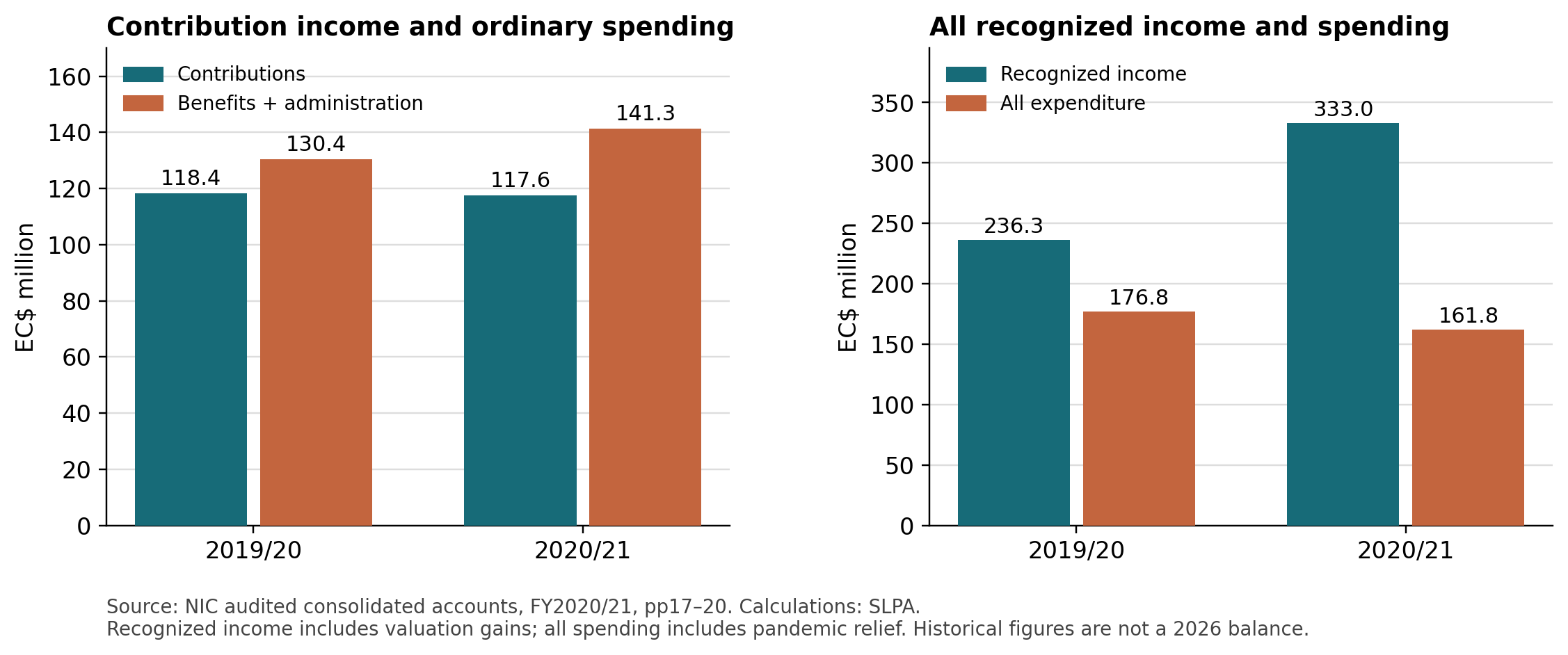
The audited FY2020/21 consolidated accounts recorded EC$117.6 million in contributions against EC$141.3 million in ordinary benefits and administration. Contributions covered about 83.2% of those costs, leaving a gap of EC$23.7 million. The report recalculates these amounts from the accounts.
Yet total recognised income was EC$333.0 million, against total spending of EC$161.8 million including emergency relief and other items. The accounts therefore reported a surplus of EC$171.2 million. Investment and other recognised income include amounts that are not immediately available cash. A surplus is not the same as money in the bank.
Those are pandemic-year figures. The accounts were authorised in March 2025, but still describe a year ending in June 2021. They were the latest audited accounts located at the report's 3 November 2026 cutoff. They cannot establish NIC's current financial position. Report page 13.
What about the dates 2035, 2051 and 2080?
The January 2026 IMF report repeats an older no-reform scenario in which total income falls below spending around 2035 and reserves are exhausted around 2051. It reports an extension to 2080 under a proposed reform package. The population study did not independently reproduce those actuarial results or verify that the proposed package had become law.
These dates need their scenario and source attached whenever they are used. They are not a new current-law valuation by SLPA. Reserve exhaustion would also not mean that all contributions suddenly stop. It would mean financing, benefits or rules need adjustment. It is not a date for national collapse.
The immediate need is the full latest actuarial review, recent audited accounts and an update that reflects the rules and benefit changes actually in force. Publishing that evidence makes choices easier to compare. It should precede claims that a particular rate or retirement age has solved the problem. Report page 14.
Judge a reform by both security and adequacy.
A pension system must pay its obligations and provide meaningful support. Raising contributions can improve receipts while reducing take-home pay and increasing employer costs. Later pension eligibility affects people differently, especially those in demanding work or poor health. Lower benefits may ease the fund's accounts while shifting hardship to households and social services.
Better coverage can help people with interrupted contribution records and improve current receipts. It also creates future pension rights. Higher wages can raise contributions and future benefits together. These feedbacks belong in the costing, rather than being treated as free money.
The report therefore proposes simpler reporting, fewer contribution gaps, protection for low-income and irregular earners, and phased changes with hardship safeguards. It does not recommend an optimal contribution rate. Its one-point contribution illustration uses a fixed historical earnings base and cannot serve as a 2026 reform budget.
Give the public a pension account they can inspect.
A useful public comparison would show the current-law path beside each reform option. Include contribution months, insurable payroll, benefit amounts, investment assumptions and liquid assets. Show how the result changes if wages, employment, returns or life expectancy differ from the central case.
Then publish who gains, who pays more, the transition period and the hardship route. Set review dates and keep earlier projections available so revisions can be explained. The aim is a clear adjustment process that protects trust and retirement income, with fewer surprises for workers and pensioners. Government public-service pensions must also remain separate from NIC in the analysis.
More questions
Will my NIC pension stop in 2051?
The report does not establish that. The date comes from a published older no-reform scenario. A current-law actuarial review, cash-flow evidence and any future policy changes are needed to assess future payments.
Can economic growth solve the problem?
Growth can help if it reaches insured earnings and contributions. But benefits and care costs may also rise. The report's 4.7% resource offset is not a pension-solvency calculation.
Why not publish one reform rate now?
The retrieved records do not support a reliable current costing. A defensible rate needs recent payroll, contributor, pensioner, benefit and investment data, together with the full valuation and legal rules in force.
Evidence you can follow
Canonical report, pages 9, 13–14, 18 and 20–23. Historical accounts and external actuarial scenarios retain their dates; this is not an individual benefit calculation.
Read the canonical report and references ↗