Population / Process explainer
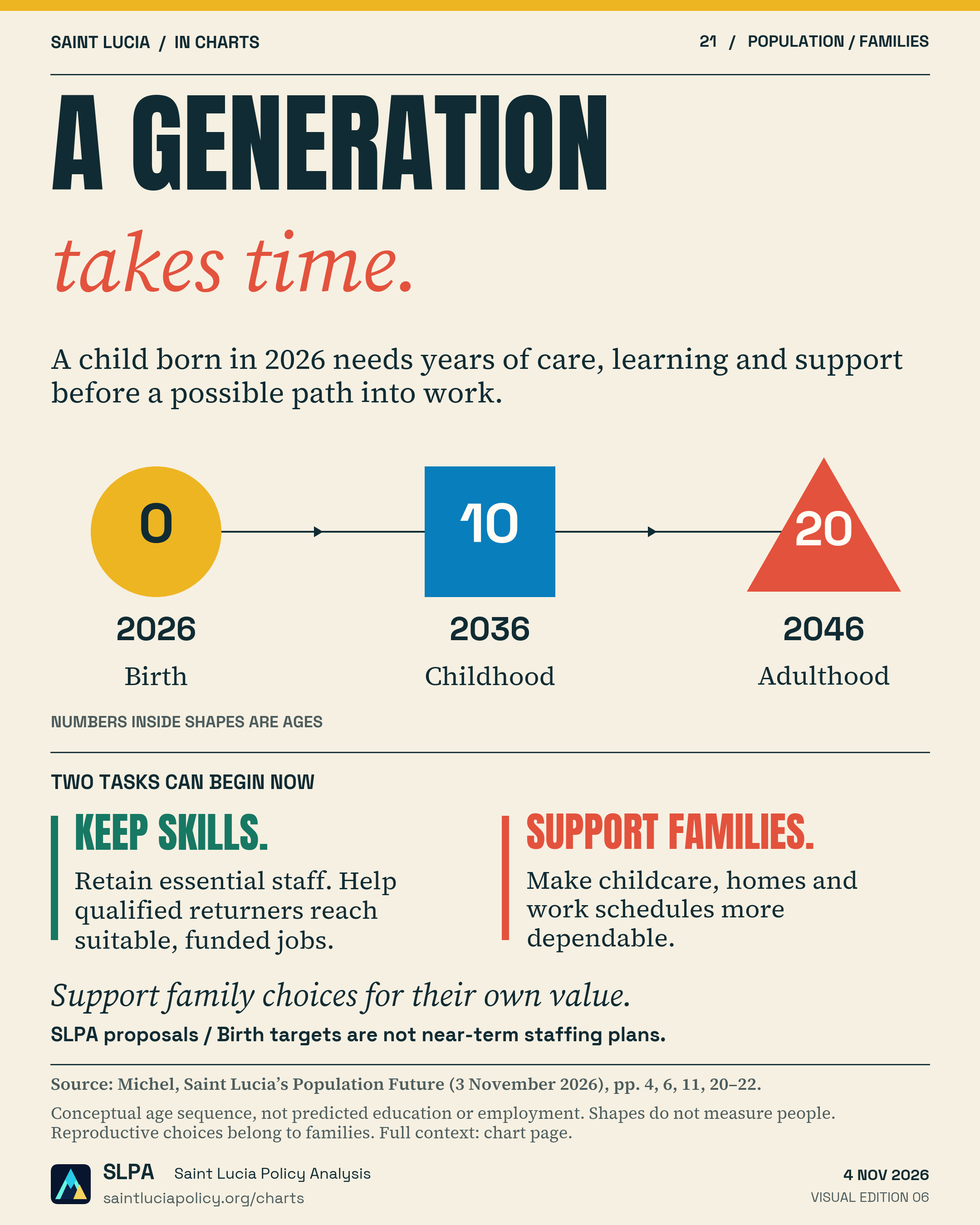
A generation takes time.
Family wellbeing, workforce needs and demographic renewal run on different clocks.
Family and workforce planning · Published
High-resolution PNG · A4 PDF · Edition 06
Reading the visual
What to look for.
Read the different time horizons as a conceptual sequence. They explain why family support and near-term staffing belong together in a plan. The example follows a child born in 2026 to age ten in 2036 and age twenty in 2046. It sets no guaranteed age for entering work and predicts no birth-rate response.
Conceptual policy explainer. Family decisions and reproductive choice must be respected. A fertility assumption is not a proven effect of a payment or programme, and children are not an immediate pension or staffing remedy.
Explore migration, families and different clocksFollow the evidence
Sources & method.
Source: Kevin L. Michel, Saint Lucia’s Population Future, 3 November 2026. Read pages 4, 6, 11, 20, 21 for the relevant evidence and calculations. Permanent DOI record.
Underlying sources: UN World Population Prospects 2024 and CSO Provisional 2022 Census, Release 2. Read the evidence and method. The report’s evidence cutoff is 3 November 2026; this visual was published on 4 November 2026.
The timeline follows a hypothetical child born in 2026. Ages ten in 2036 and twenty in 2046 illustrate elapsed time; they do not predict an individual’s education, employment or family choices.
SLPA proposes dependable childcare, housing and work schedules alongside near-term staff retention, training and workable routes for qualified return. Family support can improve lives before any demographic effect appears. A fertility assumption is not a demonstrated response to a particular programme.
The diagram is conceptual and has no measured numerical dataset. Reproductive choices belong to families. Read the different-clocks explanation and the proposed policy plan.