Population / Scenario chart
More than one way to keep up.
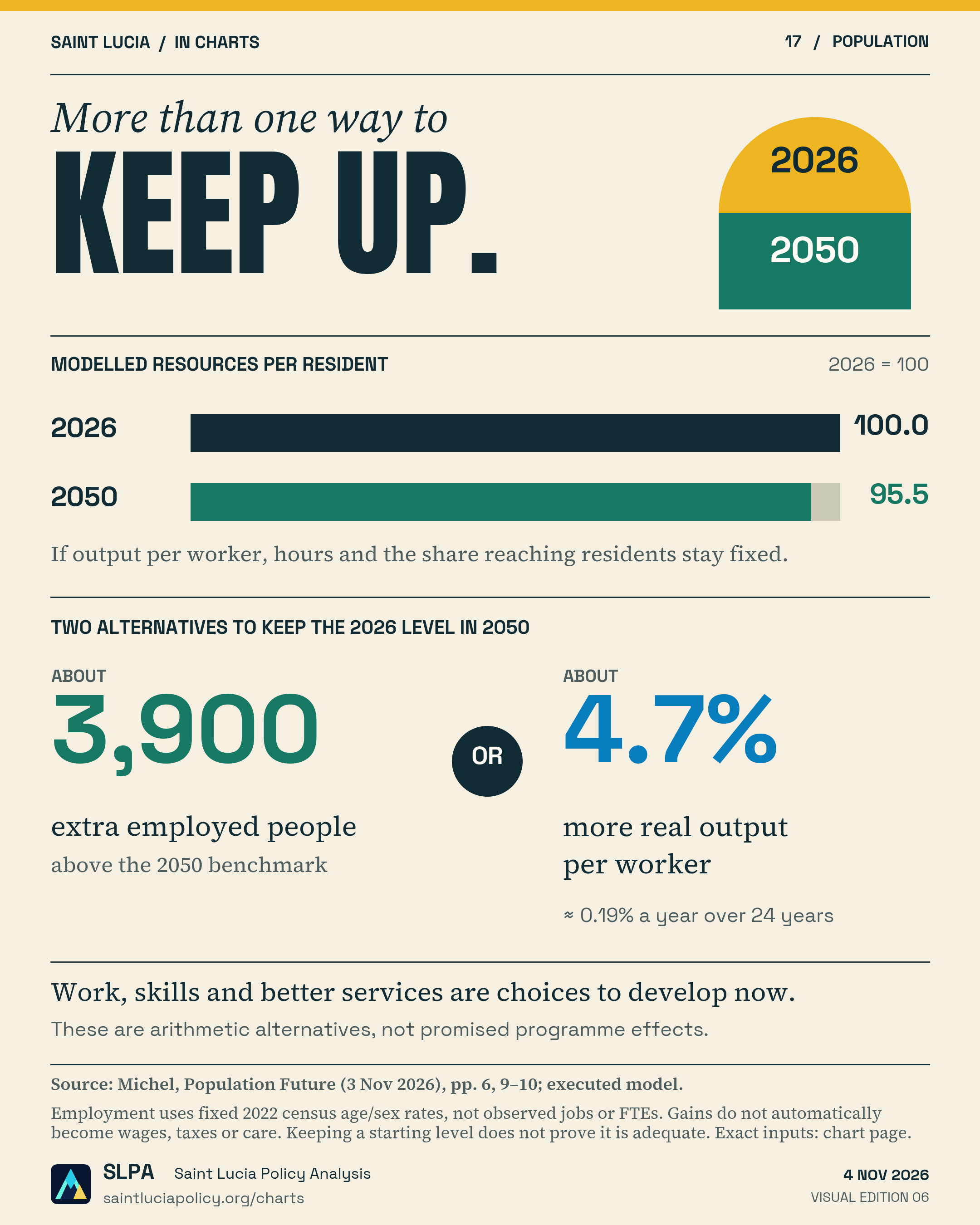
Two alternative arithmetic offsets to the benchmark’s 2050 resource gap per resident.
2050 benchmark · 2026 reference · Published
High-resolution PNG · A4 PDF · CSV data · Edition 06
Reading the visual
What to look for.
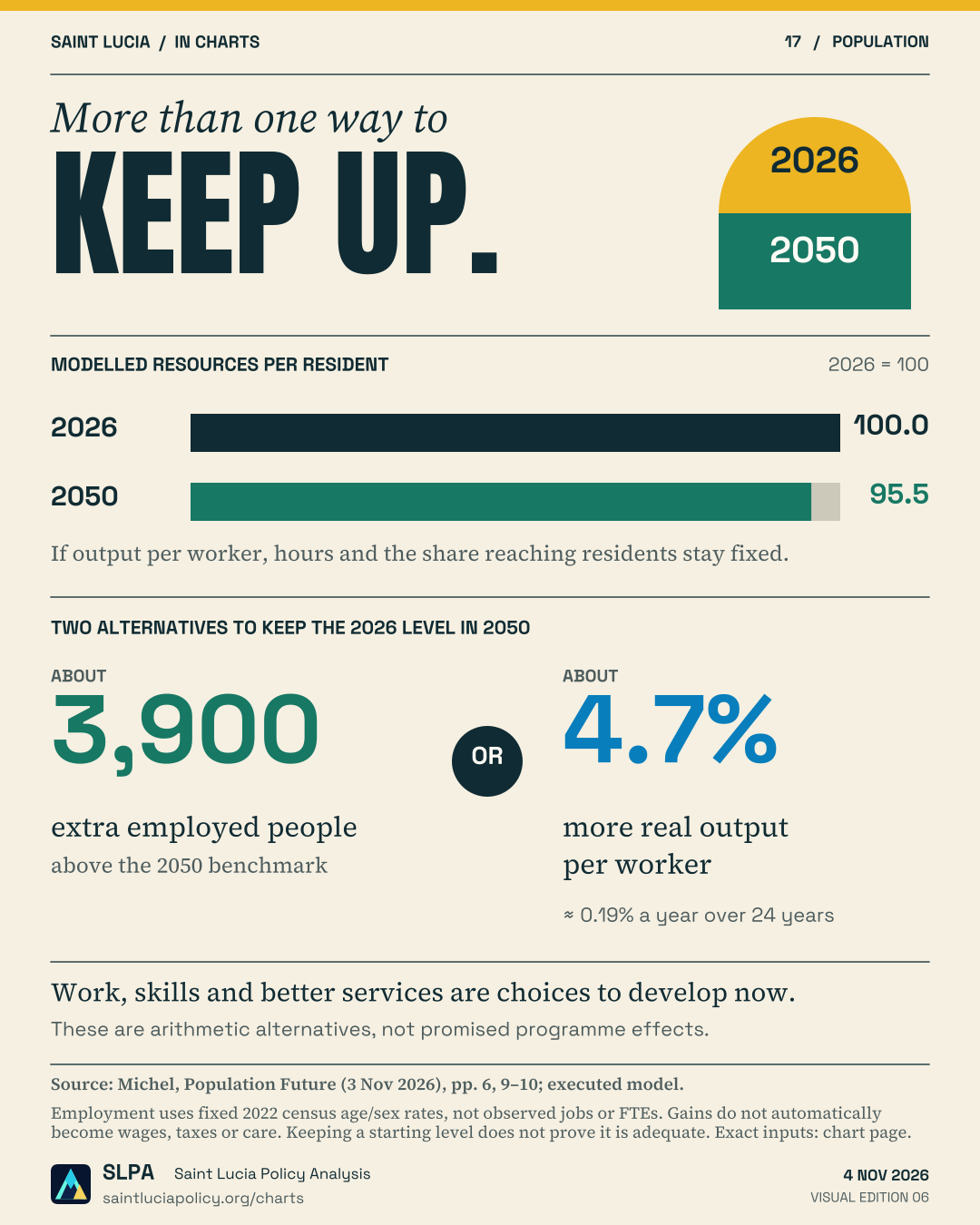
The upper bars set 2026 resources per resident to 100; the 2050 benchmark is about 95.5. Below, read the responses as alternatives: extra employment at fixed output per worker, or more output per worker at fixed modelled employment. Both restore the same starting standard.
Conditional arithmetic, not promised jobs, wage growth, tax receipts or pension solvency. Employment applies fixed 2022 census rates by age and sex. Preserving the starting standard does not establish that services were adequate in 2026.
Explore the work and resource calculationsFollow the evidence
Sources & method.
Source: Kevin L. Michel, Saint Lucia’s Population Future, 3 November 2026. Read pages 6, 9, 10 for the relevant evidence and calculations. Permanent DOI record.
Underlying sources: UN World Population Prospects 2024 and CSO Provisional 2022 Census, Release 2. Read the evidence and method. The report’s evidence cutoff is 3 November 2026; this visual was published on 4 November 2026.
| Measure | 2026 | 2050 |
|---|---|---|
| Residents | 180,510 | 172,118 |
| Modelled employed people | 90,965 | 82,873 |
| Modelled employed people per 100 residents | 50.39 | 48.15 |
| Resources per resident index (2026 = 100) | 100.0 | 95.5 |
To preserve the 2026 resources per resident in 2050, the model needs either 3,863 extra employed people at unchanged output per worker, or 4.66% more real output per worker at unchanged modelled employment. These are rounded to about 3,900 and 4.7% in the poster.
Employment offset = (2026 employed ÷ 2026 residents) × 2050 residents − 2050 employed. Output offset = [(2026 employed ÷ 2026 residents) ÷ (2050 employed ÷ 2050 residents) − 1] × 100. This holds average hours and resource capture fixed. The employment offset is not the total decline in modelled employment.
Holding the whole 2026 resource base, rather than resources per resident, needs a larger 9.8% output-per-worker gain. Neither calculation establishes pension solvency, higher tax receipts or sufficient care capacity.