More households can form without much population growth.
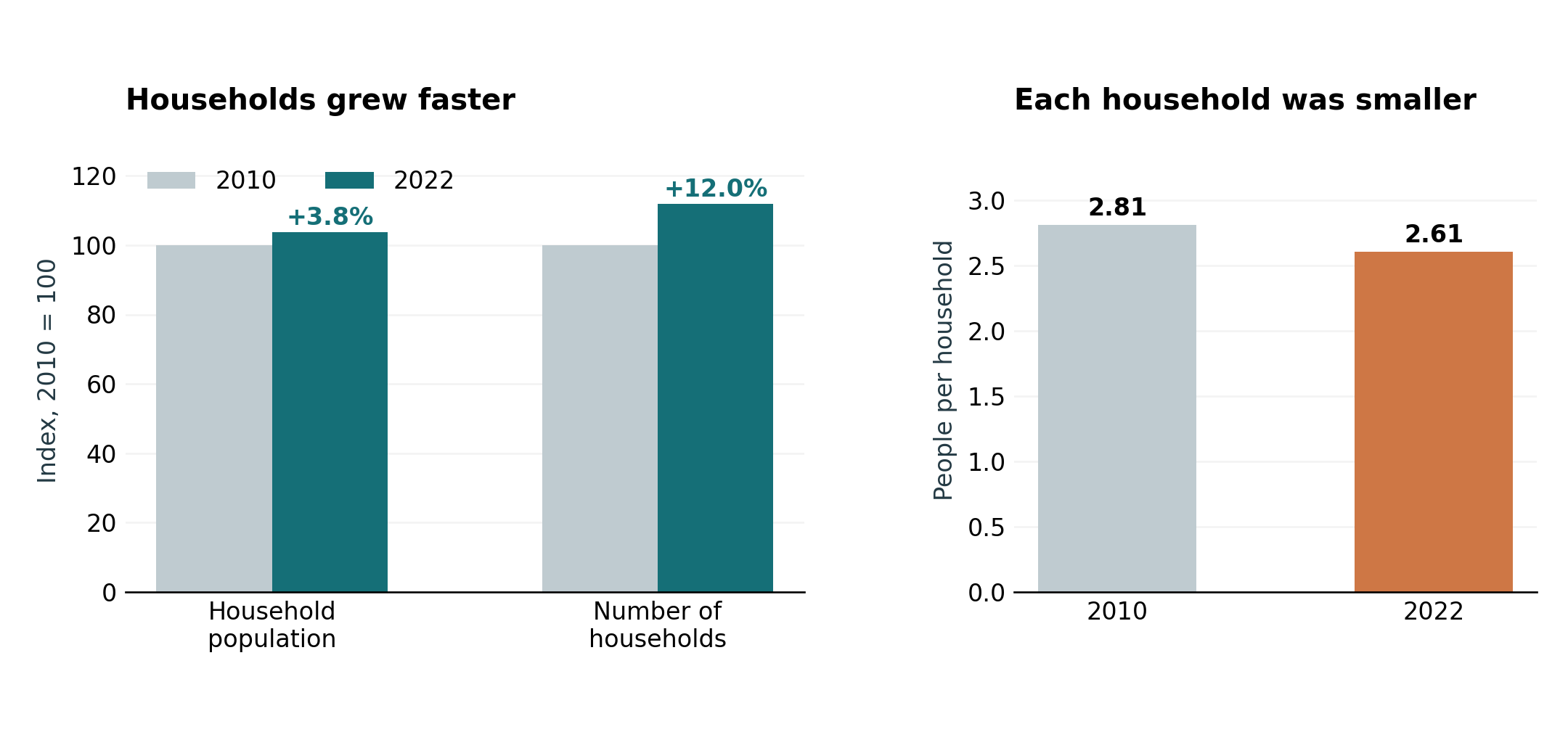
Between the 2010 and 2022 censuses, Saint Lucia's household population grew about 3.8%, while the number of households rose about 12%. Average household size fell from about 2.81 to 2.61 people. A smaller average means more separate homes may be needed for the same number of people.
About 32% of households contained one person in 2022. About 27% of people aged 65 and over who lived in households lived alone. These figures support planning for smaller, accessible homes and nearby services. They do not prove that every single-person household is lonely, unsafe or in need of formal care. Report page 15.
An empty building is not always a usable home.
Housing demand depends on location, income, ownership, inheritance, tourism use and the condition of buildings. A vacant house far from work or care is not a substitute for an affordable home near daily needs. A home with steps, poor drainage or an unreliable access road may become harder to use as a resident ages.
The report does not forecast house prices. It also does not map a population figure to mortgage rates. Interest rates reflect funding, credit risk, competition, the regional monetary system and wider conditions. The 6.39% bank lending figure reported for 2025 is an average across lending, not a mortgage quote.
A useful local housing review would join household size and age with dwelling condition, tenure, price, service access and vacancies. It should test adaptations and reuse as well as new construction. Changes in population do not remove the need to plan land, water, drainage and transport together.
Fewer pupils do not automatically solve a school problem.
Public primary enrolment fell 3.3% to 13,280 in 2024/25. Teacher numbers increased to 1,039, but the number of trained teachers fell 7.8% to 730. The same system can therefore have fewer pupils and a skills problem at the same time. The report does not establish why the trained-teacher count changed.
School decisions need school-level enrolment trends, teacher skills, learning outcomes and costs. They also need travel times and safe access, including during storms. A national decline may hide growth in a particular community. The report supplies no national enrolment threshold that justifies closing a school.
Sharing specialist teachers, using space differently or adjusting staffing may be worth testing. Each option should show the effect on children and families. A saving on a ministry's budget can become a larger transport and time burden at home. Report page 16.
Some costs remain even when fewer people use a service.
A laboratory, secure records system or specialist team has a minimum operating scale. Fewer users do not necessarily reduce every cost in proportion. This is why the report separates maintaining resources per resident from maintaining the whole starting resource base.
Regional procurement, shared specialists and referral agreements can spread some costs. Saint Lucia already belongs to regional currency and judicial arrangements. The lesson is to examine which functions can be shared, with enforceable standards and reliable transport, rather than search for one minimum national population.
Local access remains part of the calculation. Moving a service may save facility costs while increasing journeys, missed work and unpaid care. SLPA's systems approach asks where the cost goes and who bears it. The decision should show those effects before presenting consolidation as a pure saving. Report page 17.
Blood supply and storm readiness need operating measures.
Official blood appeals establish service pressure, but do not establish a demographic cause. Supply depends on eligible donors, participation, screening, usable collections, expiry and matching. There is no defensible year in this report when the population becomes too small to supply blood. Track shortages and unfilled requests by blood component and type.
Storms can interrupt care, travel, work and payments even before long-run population change becomes large. The report's separate illustrative three-year employment shock shows how interruption can reduce capacity. It is not a forecast of a named storm or a measure of Hurricane Tomas's causal effect.
Continuity plans should therefore sit inside the population response: backup routes, care visits, power, records and benefit payments. A service is resilient when it can keep meeting essential needs during disruption. A smaller or older population does not make those needs disappear.
More questions
Should falling population stop new housing?
No national rule follows from the report. Household numbers, location, affordability, accessibility and dwelling condition must be assessed together. More smaller households can need more homes even when population growth slows.
Would fewer people have benefits too?
Potentially. Pressure on some land, roads and infrastructure may ease. Smaller classes may allow more attention if teaching skills and access are preserved. These possibilities depend on how systems adapt.
Can a smaller country still work well?
Yes. The report finds no defensible universal minimum population. Service standards, revenue, staffing, shared arrangements and access determine whether particular institutions can meet their obligations.
Evidence you can follow
Canonical report, pages 15–17 and 21–23. Household calculations use the provisional census; housing prices and local service-closure thresholds are not forecast.
Read the canonical report and references ↗