A real cost for families
The UK recorded 876 visitor-visa applications from Saint Lucian nationals in April–June. Four standard short-visit applications now cost £540 in application fees alone.
Check the UK and Irish recordStatement under review · 19 November 2026
London and Dublin now require visas. Brussels wants a change in how Saint Lucia grants citizenship. What has the government offered, and how much money would a change put at risk?
SLPA’s findings
Opposition Leader Allen Chastanet is on solid ground about lost travel access, repeated reporting delays and missing financial information. Pierre has engaged foreign governments and has published spending figures. What the public still lacks is a clear account of the terms offered abroad and a way to follow the money at home.
The UK recorded 876 visitor-visa applications from Saint Lucian nationals in April–June. Four standard short-visit applications now cost £540 in application fees alone.
Check the UK and Irish recordBrussels described talks about ending the programmes. Antigua’s signed offer shows one possible bargain. We could verify neither Saint Lucia’s negotiating terms nor a formal answer to Pierre.
Reconstruct the negotiationsThree consecutive CIP audit opinions were signed after the outer September reporting date. The claim that every parliamentary deadline was missed requires more of the Clerk’s record.
See the six-year calendarPages 1–3 · Opposition statement
These are SLPA’s paraphrases. Open any claim for the finding and the underlying records. The original wording is available below.
16 of 16 claims and demands
Both governments introduced visit visas in 2026. The UK change began on 5 March and Ireland’s on 15 June. A family making a short visit now faces application fees and advance paperwork. The precise rules depend on destination, travel documents and transit arrangements.
Why London and Dublin changed the rulesEU law gives investor citizenship without a genuine link an express place in suspension decisions. Brussels is discussing a phase-out. Short visits remain visa-exempt under the published rules checked on 21 November. A deadline to answer a letter creates no entry requirement.
What has Saint Lucia told Brussels?Pierre confirmed the letter. He identified jobs, revenue and security safeguards as interests and cited diplomatic confidentiality. He has yet to disclose what Saint Lucia offered. Meetings and an on-record Commission response document negotiations.
What has Saint Lucia told Brussels?There is evidence of engagement with London. We found no published bilateral timetable, agreed thresholds or restoration commitment for either country. Whether the strategy is credible is an assessment. London and Dublin each control their own decision.
Why London and Dublin changed the rulesA fall in CIP receipts can affect the budget. Correspondent banks make separate commercial and regulatory decisions. A new visa rule supplies no proof of a lost correspondent account, a blocked remittance or a fall in trade. Obtain dated bank notices and payments data to test those risks.
Why London and Dublin changed the rulesSeptember is the outer date if the Board and minister both meet their clocks. The minister’s own deadline depends on the actual submission date. The latest published report we located covers FY2024/25. A certified tabling record and the dated handover would establish what happened this year.
When were the CIP reports due?Late signed audit reports establish repeated delays in completing the statutory package. Several cannot have accompanied an on-time report. For the claim about every parliamentary laying, the parliamentary register and each dated handover still matter.
When were the CIP reports due?Developments can have billion-dollar announced values. An announced cost, an approved purchase and a deposited payment are different records. The statement gives no currency, period or calculation for a nationwide total of citizenship-linked sales. Project accounts could settle it.
Where did the citizenship money go?The Unit records its own fees, costs and transfers. Investors also make payments into project escrow. Section 24(2)(c) calls for investment amounts and details in the annual report. An auditor’s opinion on the Unit alone cannot reconcile the project accounts.
Where did the citizenship money go?The statistical mission attributes that estimate to the CIP Unit. The denominator was financial resources raised by the programme. The report supplies no dated annual series that would turn it into today’s share of Treasury revenue.
Where did the citizenship money go?The IMF documented the missed commitment at its 2024 mission and published the findings in 2025. Its January 2026 Article IV still records the gap. A current delivery receipt would update the finding. A gap in statistics cannot establish where cash went.
Where did the citizenship money go?The public can reasonably ask what CIP financed. Each service needs its own baseline and outcome measure. Countrywide price or crime movements alone cannot tell us what a particular CIP payment achieved.
What reached households?The earlier Opposition letter asked how money reportedly made available had moved. The 19 November statement describes a completed transfer. Neither the reported EC$100m NEF receipt nor EC$52.98m of social-development spending establishes an EC$110m receipt by the SSDF.
Can the EC$110 million transfer be traced?Pierre gave a written answer on audit governance in July. The published account does not itemise the alleged transfers. The full dated November correspondence set remains unverified. Whether the answer was substantive depends on which question it addressed.
Can the EC$110 million transfer be traced?These are allegations. An August police statement concerned an undisclosed matter, with no established link to this allegation. An independent complaints process can protect applicants and due process while an auditor separately tests where funds went.
Can the EC$110 million transfer be traced?These are policy demands. SLPA supports a public mandate and dated scrutiny, a separate restoration effort with each partner, delivery of the statutory papers, and independent tests of fund transfers. Parliament can receive a confidential annex during live talks.
A negotiating mandate for Saint LuciaThe investigation
Follow the letters, the meetings and the legal steps that could change travel.
Travel & bankingCheck the dates, visa costs, asylum figures and prospects for a review.
Caribbean comparisonRead Antigua’s four-page offer and compare it with three neighbouring governments’ positions.
ParliamentFollow the report from the Board to the minister to Parliament, year by year.
Public financeCheck the IMF’s 75%, the Canelles escrow account and two official figures for bonds.
Social assistanceCompare the letters, the Prime Minister’s reply, the audit record and the evidence still needed.
Public servicesTest the claims about prices, hospitals, roads and crime against measures of actual service.
Policy decisionA 90-day plan to protect travel, finance essential services and manage existing promises.
Primary document
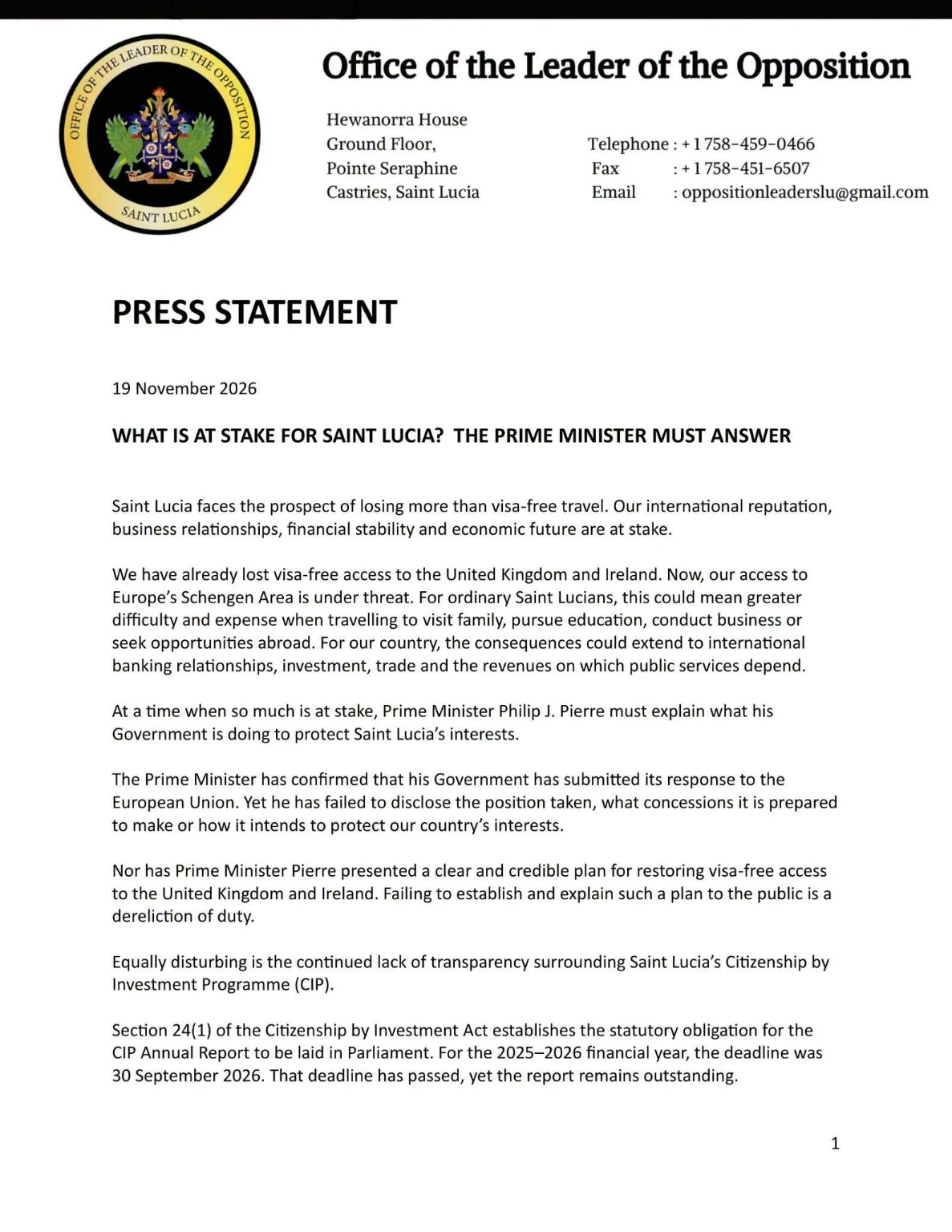
The Office of the Leader of the Opposition issued this statement on 19 November 2026. Each scan opens at full size. The transcripts reproduce the statement’s body in the Opposition’s own words.
Open original page 1Travel access and the CIP annual report
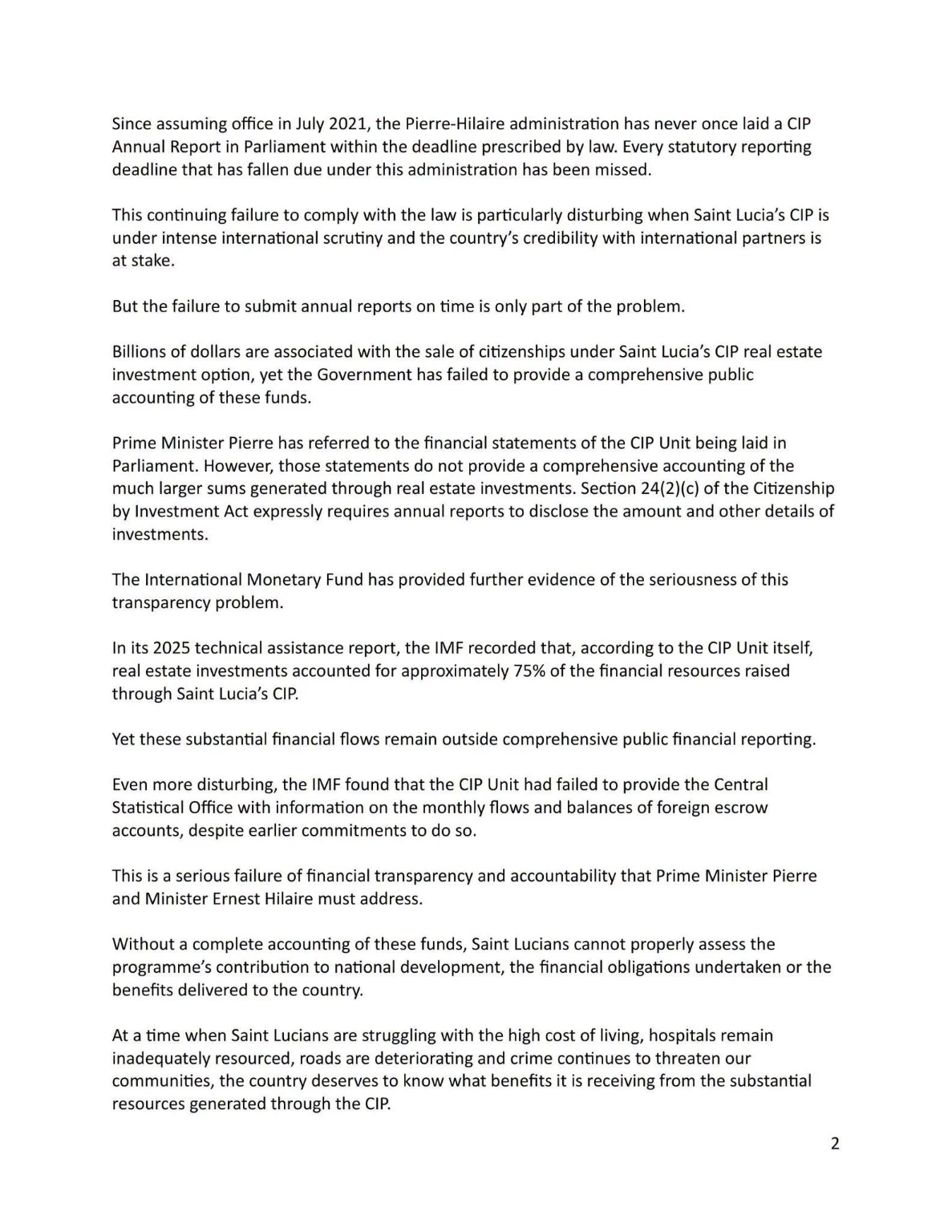 Open original page 2
Real estate investments and foreign escrow accounts
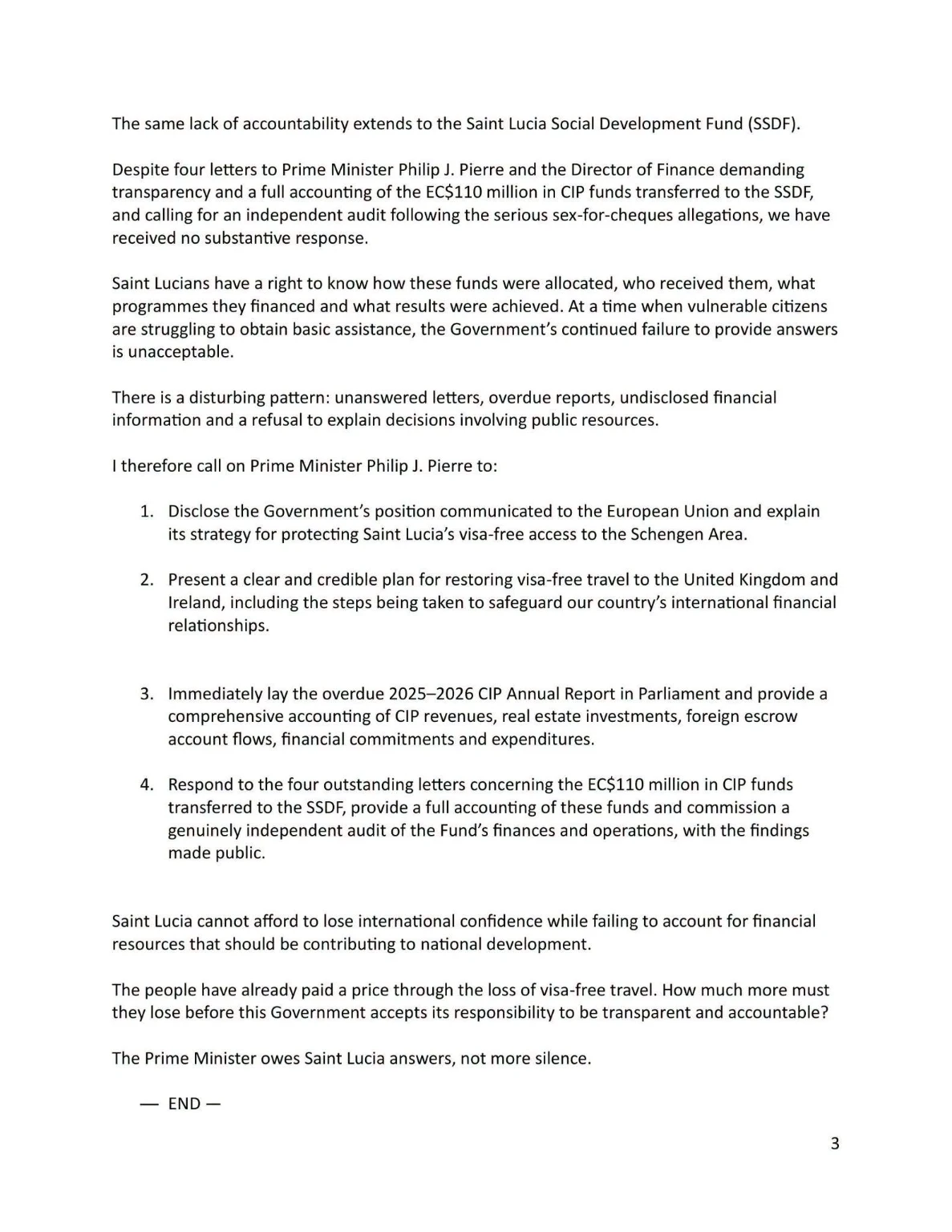 Open original page 3
The Social Development Fund and the four requests
PRESS STATEMENT
19 November 2026
WHAT IS AT STAKE FOR SAINT LUCIA? THE PRIME MINISTER MUST ANSWER
Saint Lucia faces the prospect of losing more than visa-free travel. Our international reputation, business relationships, financial stability and economic future are at stake.
We have already lost visa-free access to the United Kingdom and Ireland. Now, our access to Europe’s Schengen Area is under threat. For ordinary Saint Lucians, this could mean greater difficulty and expense when travelling to visit family, pursue education, conduct business or seek opportunities abroad. For our country, the consequences could extend to international banking relationships, investment, trade and the revenues on which public services depend.
At a time when so much is at stake, Prime Minister Philip J. Pierre must explain what his Government is doing to protect Saint Lucia’s interests.
The Prime Minister has confirmed that his Government has submitted its response to the European Union. Yet he has failed to disclose the position taken, what concessions it is prepared to make or how it intends to protect our country’s interests.
Nor has Prime Minister Pierre presented a clear and credible plan for restoring visa-free access to the United Kingdom and Ireland. Failing to establish and explain such a plan to the public is a dereliction of duty.
Equally disturbing is the continued lack of transparency surrounding Saint Lucia’s Citizenship by Investment Programme (CIP).
Section 24(1) of the Citizenship by Investment Act establishes the statutory obligation for the CIP Annual Report to be laid in Parliament. For the 2025–2026 financial year, the deadline was 30 September 2026. That deadline has passed, yet the report remains outstanding.
Since assuming office in July 2021, the Pierre-Hilaire administration has never once laid a CIP Annual Report in Parliament within the deadline prescribed by law. Every statutory reporting deadline that has fallen due under this administration has been missed.
This continuing failure to comply with the law is particularly disturbing when Saint Lucia’s CIP is under intense international scrutiny and the country’s credibility with international partners is at stake.
But the failure to submit annual reports on time is only part of the problem.
Billions of dollars are associated with the sale of citizenships under Saint Lucia’s CIP real estate investment option, yet the Government has failed to provide a comprehensive public accounting of these funds.
Prime Minister Pierre has referred to the financial statements of the CIP Unit being laid in Parliament. However, those statements do not provide a comprehensive accounting of the much larger sums generated through real estate investments. Section 24(2)(c) of the Citizenship by Investment Act expressly requires annual reports to disclose the amount and other details of investments.
The International Monetary Fund has provided further evidence of the seriousness of this transparency problem.
In its 2025 technical assistance report, the IMF recorded that, according to the CIP Unit itself, real estate investments accounted for approximately 75% of the financial resources raised through Saint Lucia’s CIP.
Yet these substantial financial flows remain outside comprehensive public financial reporting.
Even more disturbing, the IMF found that the CIP Unit had failed to provide the Central Statistical Office with information on the monthly flows and balances of foreign escrow accounts, despite earlier commitments to do so.
This is a serious failure of financial transparency and accountability that Prime Minister Pierre and Minister Ernest Hilaire must address.
Without a complete accounting of these funds, Saint Lucians cannot properly assess the programme’s contribution to national development, the financial obligations undertaken or the benefits delivered to the country.
At a time when Saint Lucians are struggling with the high cost of living, hospitals remain inadequately resourced, roads are deteriorating and crime continues to threaten our communities, the country deserves to know what benefits it is receiving from the substantial resources generated through the CIP.
The same lack of accountability extends to the Saint Lucia Social Development Fund (SSDF).
Despite four letters to Prime Minister Philip J. Pierre and the Director of Finance demanding transparency and a full accounting of the EC$110 million in CIP funds transferred to the SSDF, and calling for an independent audit following the serious sex-for-cheques allegations, we have received no substantive response.
Saint Lucians have a right to know how these funds were allocated, who received them, what programmes they financed and what results were achieved. At a time when vulnerable citizens are struggling to obtain basic assistance, the Government’s continued failure to provide answers is unacceptable.
There is a disturbing pattern: unanswered letters, overdue reports, undisclosed financial information and a refusal to explain decisions involving public resources.
I therefore call on Prime Minister Philip J. Pierre to:
- Disclose the Government’s position communicated to the European Union and explain its strategy for protecting Saint Lucia’s visa-free access to the Schengen Area.
- Present a clear and credible plan for restoring visa-free travel to the United Kingdom and Ireland, including the steps being taken to safeguard our country’s international financial relationships.
- Immediately lay the overdue 2025–2026 CIP Annual Report in Parliament and provide a comprehensive accounting of CIP revenues, real estate investments, foreign escrow account flows, financial commitments and expenditures.
- Respond to the four outstanding letters concerning the EC$110 million in CIP funds transferred to the SSDF, provide a full accounting of these funds and commission a genuinely independent audit of the Fund’s finances and operations, with the findings made public.
Saint Lucia cannot afford to lose international confidence while failing to account for financial resources that should be contributing to national development.
The people have already paid a price through the loss of visa-free travel. How much more must they lose before this Government accepts its responsibility to be transparent and accountable?
The Prime Minister owes Saint Lucia answers, not more silence.
— END —
Evidence through 21 November 2026
This is a public-record investigation. Ministerial accounts establish what ministers said. Signed audits, statutes and partner decisions answer different questions. The regional opposition statement dated 18 November is a separate document. The questions below identify records for follow-up.
A dated acknowledgment, publishable summary and negotiation milestones.
Board transmittals, signed audits and parliamentary journal entries with paper numbers.
A signed reconciliation by project and year, and dated confirmation of statistical coverage.
A correspondence index and matching bank-confirmed entries on both sides of each transfer, with personal details protected.